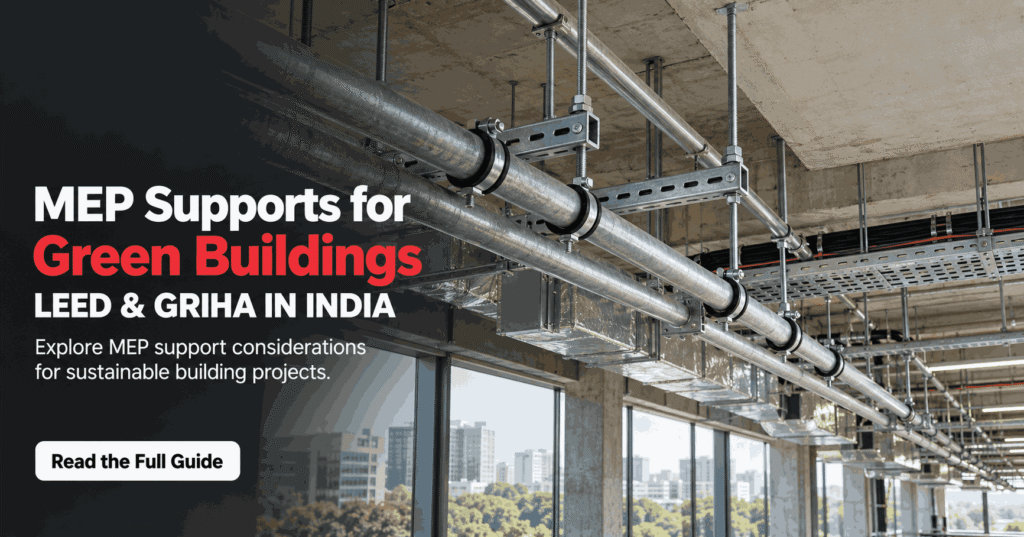
MEP support for a green building under LEED or GRIHA in India means choosing pipe, cable, and duct support that helps a project earn its sustainability rating rather than working against it. Strut channel, brackets, and fasteners are made from steel, one of the most recyclable materials there is, so support with high recycled content and full end-of-life recyclability can contribute to the materials credits both LEED and GRIHA award. Durable, corrosion-protected support also lasts longer, which cuts replacement and waste over a building’s life. And sourcing support regionally can support the local-materials credits these rating systems recognise. In short, the right MEP support is a small but real part of a green building’s score. Ashish International, with 25+ years in MEP supports, manufactures recycled-content strut channel and fittings suited to LEED and GRIHA projects, supplied across India and worldwide.
How MEP Support Contributes to a Green Rating
MEP support is a small line item, but on a green building even small choices add up across the materials and waste categories. Support can help a rating in several ways:
Recycled content: steel channel and fittings can carry high recycled content, feeding the materials credits LEED and GRIHA award.
Recyclability: steel is fully recyclable at end of life, so support does not become landfill waste.
Durability: corrosion-protected support lasts decades, cutting the replacements and waste of a shorter-lived system.
Regional sourcing: support made and bought regionally can contribute to local-materials credits.
Efficient design: right-sized support uses less steel for the same job, lowering embodied material.
The point that matters most is that these are contributions, not guarantees. The final credit depends on the project’s full documentation and the rating system’s rules. Choose support with recycled content, recyclability, and durability in mind and it works for the green score rather than against it.
Why Steel Is a Green-Friendly Support Material
Steel earns its place in sustainable building because of how it is made and re-made. It is one of the most recycled materials in the world, and steel support can be produced with a significant share of recycled content while performing exactly like new steel. At the end of a building’s life, the channel, brackets, and fasteners can be recycled again rather than dumped, creating a closed loop that few support materials match. Corrosion protection adds to this: a hot dip galvanised or stainless steel channel lasts far longer than bare steel, so it is replaced less often, cutting the material and waste of repeat installs. Because steel support is recyclable, durable, and made with recycled content, it fits a green building’s material goals rather than fighting them.
Where Support Can Support the Credits
Different green-building credits touch MEP support in different ways. The table below maps the main ones to how support can help.
| Credit area | How MEP support can contribute |
|---|---|
| Recycled content (materials) | High recycled-content steel channel and fittings |
| Construction waste | Recyclable offcuts and end-of-life recyclability |
| Regional materials | Support sourced and made regionally |
| Building durability | Corrosion-protected support that lasts, reducing replacement |
| Resource efficiency | Right-sized, standardised support using less steel |
The clearest opportunity is recycled content, since steel support naturally carries it and both LEED and GRIHA reward it under their materials sections. Specify support with these credits in mind and it becomes a documented contributor to the rating, not a missed chance.
How to Specify Sustainable MEP Support
Turning green intent into a real specification is a short, ordered process:
Ask for recycled content data: request the recycled-content figure for the steel used.
Confirm recyclability: check the support is fully recyclable at end of life.
Right-size the design: use correctly sized MEP support structures so no steel is wasted on over-specification.
Choose durable finishes: galvanised or stainless for long life and fewer replacements.
Source regionally where possible: regional supply can support local-materials credits and cut transport impact.
Documentation drives the whole effort at step one, because a green credit is earned on paper as much as in the product. The recycled-content and sourcing data is what the rating assessor needs. Specify support for both performance and paperwork, and it earns its place in a certified building.
Design Efficiency Counts Too
Beyond materials, using less steel for the same job helps. Right-sizing channel and choosing efficient sections like a back-to-back strut channel only where the load truly needs it avoids over-specifying, which quietly lowers the embodied steel in a support system. Efficient design is sustainability that costs nothing extra. It simply means not using more material than the load requires.
Sustainable Support, Backed by Real Manufacturing
A green claim is only as good as the data behind it. A project assessor needs real recycled-content and sourcing figures, not marketing. Ashish International backs that with 25+ years of manufacturing across three units and 60,000 square feet, producing 350 tonnes of MEP support a month under in-house quality control, with recycled-content steel and documentation to support project submissions. Green-building contractors, sustainability consultants, stockists, and sourcing companies across the UK, Europe, the Middle-East, Australia, and Africa work with us for that transparency, and several have partnered with us for over 20 years, some under NDA for their own designs. We manufacture to the dimensional and load standards global specifiers expect, and for brands and MNCs we run the full range as white-label, your spec, your branding, with FITSTRUTS® where a stock line fits. For recycled-content data, product specifications, or a white-label discussion, call +91-99888-54380 or email ashishint2001@gmail.com.
1. How does MEP support contribute to a LEED or GRIHA rating?
Strut channel and fittings are made from steel, which can carry high recycled content and is fully recyclable, feeding the materials and waste credits LEED and GRIHA award. Durable, regionally sourced support also cuts replacement waste and can support local-materials credits. These are contributions, confirmed by project documentation.
2. Is strut channel made from recycled steel?
Steel is one of the most recycled materials in the world, and strut channel can be produced with a significant share of recycled content while performing like new steel. At end of life, it can be recycled again, making it a closed-loop, green-friendly support material. Ask your supplier for the recycled-content figure.
3. Does durable MEP support help sustainability?
Yes. Corrosion-protected support such as galvanised or stainless channel lasts far longer than bare steel, so it is replaced less often. Fewer replacements mean less material used and less construction waste over the building’s life, which supports the durability and waste goals of green rating systems.
4. What data do I need to claim green credits for MEP support?
Assessors typically want the recycled-content percentage of the steel, confirmation of end-of-life recyclability, and sourcing or regional-manufacture details. Having this documentation from your supplier is what lets MEP support count toward LEED or GRIHA materials and regional credits.
5. Can you provide recycled-content documentation for green projects?
Yes. We can supply recycled-content and sourcing data to support LEED and GRIHA submissions, alongside standard product specifications. We also manufacture to your drawings, with white-label supply for green-building contractors, stockists, and sourcing partners under NDA.