
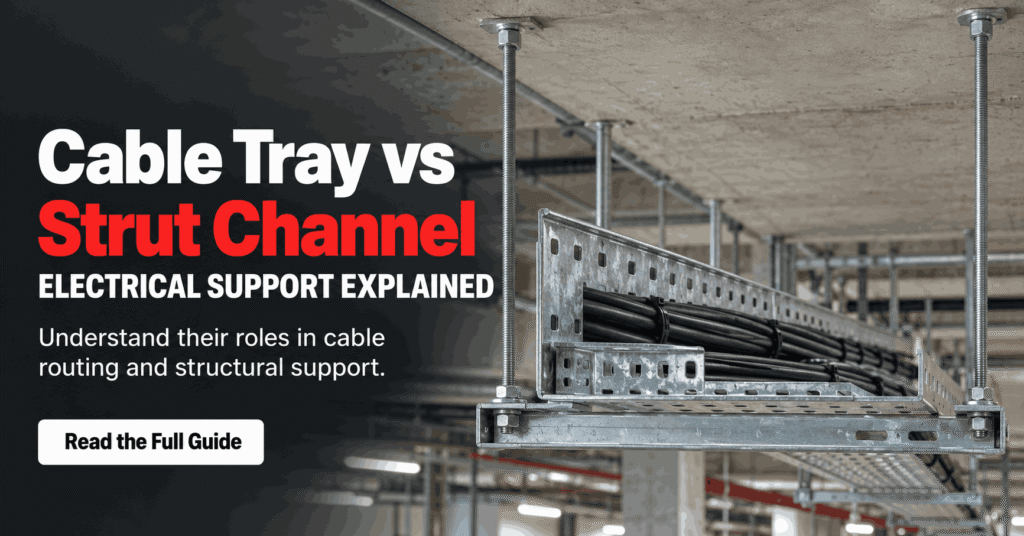
In the choice of cable tray vs strut channel for electrical support, the two are not really rivals because a cable tray carries the cables, while strut channel is the framing that holds the tray, conduit, or clamps up in the first place. A cable tray is an open metal trough that routes many power or data cables along a run, spreading their weight and letting heat escape. Strut channel is a slotted metal beam used to build the support frame, including the trapezes, brackets, and wall mounts, that the tray or conduit sits on. So on most jobs you use both: strut channel to build the support, and cable tray to hold the cables. You choose conduit instead when a few cables need full mechanical or fire protection. Ashish International, with 25+ years in MEP supports, manufactures strut channel and cable support components used across electrical projects, and this guide explains what each does and when to use which.
Clearing Up a Common Confusion
Many people compare cable tray and strut channel as if you must pick one, but they do different jobs, and understanding that settles most of the question. A cable tray is a containment system, meaning its whole purpose is to hold and route cables. Strut channel is a support system, meaning its purpose is to build the structure that holds things up, whether that is a cable tray, a run of conduit, a pipe, or a light fitting. In a typical electrical installation, strut channel forms the trapeze or bracket, and the cable tray bolts onto it. Comparing them directly is a bit like comparing a shelf to the bracket that holds the shelf. See strut channel as the support and cable tray as the thing being supported, and every other choice falls into place.
Cable Tray vs Strut Channel, Side by Side
The table below sets out the real differences in role, so you can see where each belongs in an electrical support comparison.
| Feature | Cable Tray | Strut Channel |
|---|---|---|
| Main job | Holds and routes cables | Builds the support frame |
| Form | Open trough or ladder | Slotted C-section beam |
| Carries | Many cables along a run | Trays, conduit, clamps, pipe |
| Heat dissipation | Good, open design | Not applicable |
| Used with | Sits on strut channel supports | Supports trays, conduit, fittings |
| Best for | Large cable volumes | Framing any support |
The decisive row is “main job”: one contains cables, the other builds structure, which is why most installations need both. Read the comparison by role rather than by looks and they clearly belong together rather than in competition.
When to Use Each and Conduit Too
The right choice follows the cable volume and the protection needed. Match the method to the run:
Cable tray: best for many power or data cables running together; the open design spreads load and lets heat escape.
Conduit: best for a few cables needing full mechanical or fire protection, fully enclosing them in a tube.
Strut channel: used with either, to build the trapezes, brackets, and mounts that carry the tray or conduit.
The common mistake is treating conduit vs strut channel as a like-for-like choice. Conduit encloses cables, while strut channel supports the conduit, so they too work together, not against each other. Match cable volume and protection to tray, conduit, or both, all carried on strut channel, and an electrical run stays clean and safe.
How They Work Together in Practice
On a real electrical installation, the three parts form a clear hierarchy, each doing its job. Strut channel is fixed to the ceiling or wall as a trapeze on threaded rod, a cantilever bracket, or a wall frame. The cable tray then bolts onto that strut channel framework, and the cables lay into the tray. Where a few cables need protecting, conduit is clamped to the same strut channel instead of a tray.
The Fittings That Tie It Together
The connections matter as much as the main parts. Spring channel nuts let brackets and tray fixings slot into the channel anywhere along its length, while beam clamps fix the whole frame to structural steel and cantilever arms carry trays out from a wall. Because the channel’s slotted design accepts fittings anywhere, the same framework adapts to trays, conduit, and future additions without re-drilling. Build the support from strut channel and add the tray or conduit onto it, and an electrical run is both strong and easy to extend.
How to Specify the Right System
Putting it together is a short, ordered decision:
Count the cables: many cables point to a tray; a few point to conduit.
Check the protection needed: mechanical or fire protection favours conduit.
Choose the containment: tray, conduit, or a mix, based on the above.
Design the support: build trapezes, brackets, or wall frames from strut channel sized to the load.
Match the finish: galvanised or stainless support to suit the environment, with matched fittings.
The support is won or lost at step four, because even the best tray fails if its strut-channel frame is undersized. Choose the containment first, then engineer the strut-channel support beneath it, and the result is a reliable electrical support structure.
The Support Side of Your Cable System, Covered
A cable tray is only as secure as the framework under it, and that framework is exactly what a strut-channel maker is built to supply. Ashish International brings 25+ years across three units and 60,000 square feet, at 350 tonnes a month under in-house quality control, producing channel, brackets, and fittings that carry cable trays and conduit to consistent, compatible dimensions. Electrical contractors, panel builders, stockists, and sourcing companies across the UK, Europe, the Middle-East, Australia, and Africa rely on that consistency, and several have worked with us for over 20 years, some under NDA for their own designs. We manufacture to the dimensional standards global specifiers expect, and for brands and MNCs we run the full range as white-label, your spec, your branding, with FITSTRUTS® where a stock line fits. For load data, product details, or a white-label discussion, call +91-99888-54380 or email ashishint2001@gmail.com.
1. What is the difference between cable tray and strut channel?
A cable tray is an open metal trough that holds and routes cables, while strut channel is a slotted beam used to build the support frame that the tray, conduit, or clamps sit on. They are not rivals. Strut channel supports the cable tray, so most installations use both.
2. Should I use cable tray or strut channel for electrical support?
You usually use both. Use a cable tray to carry many cables along a run, and use strut channel to build the trapezes, brackets, or wall frames that hold the tray up. For a few cables needing protection, use conduit clamped to strut channel instead of a tray.
3. What is the difference between conduit and strut channel?
Conduit is a tube that fully encloses and protects a small number of cables, while strut channel is the framing that supports the conduit, tray, or pipe. They work together. The conduit holds the cables, and the strut channel holds the conduit, rather than being an either-or choice.
4. When should I use conduit instead of a cable tray?
Use conduit when a small number of cables need full mechanical or fire protection, since it fully encloses them. Use a cable tray when many cables run together, because its open design spreads the load and lets heat escape. Both are supported on strut channel.
5. Do you supply the strut-channel supports for cable tray systems?
Yes. We manufacture the strut channel, brackets, cantilever arms, and fittings that carry cable trays and conduit, to compatible dimensions and to your load requirements. This includes white-label supply for electrical contractors, stockists, and sourcing partners, with proprietary designs under NDA.