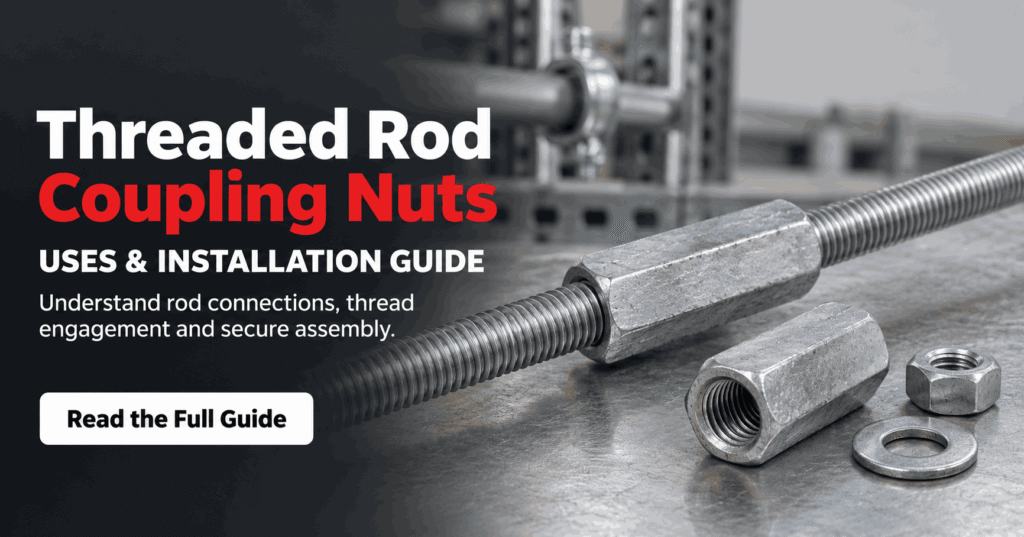
A threaded rod coupling nut is a long hex nut used to join two lengths of threaded rod end to end, or to extend a single rod, giving one continuous run. It works like a standard hex nut but is much longer, so each rod screws deep inside from either end and meets in the middle, sharing the load across a long stretch of thread. This is how installers extend a hanger drop that is too short, or make up a long threaded-rod run from standard lengths on site. The extra length is the whole point: more thread engagement means a stronger, more reliable joint than a short nut could give. To install one, you thread each rod in until it meets in the centre, checking full engagement through the sight hole many coupling nuts have. Ashish International, with 25+ years manufacturing MEP fasteners, produces threaded rod and coupling nuts to matched grades, and this guide covers their uses and correct installation.
What a Coupling Nut Does and How It Differs
A coupling nut looks like a stretched hex nut, and that extra length is exactly what sets it apart. A standard hex nut is short: it locks a bolt or holds a washer, but it is not made to join two rods, because too little thread would engage on each side. A coupling nut is long enough that each rod screws several diameters deep into it from opposite ends, so the joint carries load across plenty of thread rather than a few turns. Many coupling nuts also have a small sight or witness hole in the middle, letting you see that both rods have run in far enough to meet properly. The result is a rod-to-rod joint nearly as strong as a continuous rod, when installed right. See the coupling nut as a purpose-built rod joiner, not just a big hex nut, and its role is clear.
Where Coupling Nuts Are Used
Coupling nuts solve a handful of common site problems, and knowing them helps you spec the right part. The main uses:
-
Extending a hanger drop: lengthening a threaded rod that is too short to reach the fixing point.
-
Joining standard lengths: making a long run from shorter stock rods instead of one custom length.
-
Connecting rod to a fitting: joining threaded rod to another threaded component.
-
Adjusting on site: fine-tuning a drop length when the exact rod length was not known in advance.
-
Repair and modification: extending or reconnecting a rod when a layout changes.
Extending a drop is the most common use by far, since real ceilings rarely match the standard rod lengths on the truck. Reach for a coupling nut whenever a rod needs to be longer or joined, and the fix is quick and strong.
Coupling Nut vs Hex Nut, Side by Side
The two are easy to confuse, so the table below sets out how they differ and when to use each.
| Feature | Coupling Nut | Standard Hex Nut |
|---|---|---|
| Length | Long (several diameters) | Short |
| Main job | Join or extend threaded rod | Lock a bolt or hold a fixing |
| Thread engagement | Deep on both ends | Single, short |
| Sight hole | Often present, to check engagement | None |
| Use in a hanger | Extend or join the rod drop | Secure the fixing at the end |
The row that matters most is thread engagement, because it is the deep, two-sided engagement that makes a coupling nut safe to carry load across a joint. Use a coupling nut to join rod and a hex nut to secure a fixing, and each does the job it is built for.
How to Install a Coupling Nut Correctly
Fitting a coupling nut is simple, but getting full engagement is what makes the joint safe. Follow these steps:
-
Match the grade and size: use a coupling nut of the same thread size and a compatible grade to the rod.
-
Thread the first rod in: screw one rod into the nut until it reaches the centre.
-
Thread the second rod in: screw the other rod in from the opposite end until both meet in the middle.
-
Check the sight hole: confirm both rods are visible or meeting at the witness hole, showing full engagement.
-
Verify no gap: make sure neither rod is under-engaged, which would weaken the joint.
The sight-hole check is the step that guarantees a safe joint, because a rod screwed in only part way looks finished from outside but carries far less load. Thread both rods to full depth and confirm it, and the coupling is as dependable as the rod itself.
Matching Grade and Finish to the Job
A coupling nut is part of a load path, so it must match the rod it joins. Use the same property grade, a coupling nut on an 8.8 structural rod should suit that load, not a lighter class, and the same finish, whether galvanised for outdoor or stainless for corrosive sites, so the joint does not become the weak or rusting point. This is the same matched-component logic behind any reliable hanger, where rod, nut, and industrial fasteners all share grade and finish. Match the coupling nut to the rod’s grade and finish, and the joint carries load and resists corrosion as well as the rest of the run.
Rod and Couplings Made to Work Together
A coupling joint is only as good as the rod and nut being made to matching threads and grades. A sloppy thread or a mismatched grade turns the joint into the weak link. Ashish International brings 25+ years across three units and 60,000 square feet, producing 350 tonnes of MEP support a month under in-house quality control, so rod and coupling nuts thread cleanly and share consistent grade and finish. MEP contractors, stockists, and sourcing companies across the UK, Europe, the Middle-East, Australia, and Africa rely on that matched quality, and several have worked with us for over 20 years, some under NDA for their own designs. We manufacture rod, coupling nuts, and matched fittings to the standards global specifiers expect, and for brands and MNCs we run the full range as white-label: your grade, your branding, with FITSTRUTS® where a stock line fits. For product data, samples, or a white-label discussion, call +91-99888-54380 or email ashishint2001@gmail.com.
1. What is a threaded rod coupling nut used for?
A coupling nut is a long hex nut used to join two lengths of threaded rod end to end or to extend a single rod into one continuous run. It is commonly used to lengthen a hanger drop that is too short, or to make a long run from standard stock rods on site.
2. What is the difference between a coupling nut and a hex nut?
A coupling nut is much longer than a standard hex nut, so a rod can screw deep into it from each end and share the load across plenty of thread. A hex nut is short and made to lock a bolt or hold a fixing, not to join two rods. Use a coupling nut to join rod, a hex nut to secure a fixing.
3. How do I install a threaded rod coupling nut correctly?
Match the nut’s thread size and grade to the rod, then thread one rod in until it reaches the centre and the second rod in from the other end until both meet. Check the sight or witness hole to confirm both rods are fully engaged, with no under-engaged gap that would weaken the joint.
4. What is the sight hole on a coupling nut for?
The small hole in the middle of many coupling nuts lets you see that both threaded rods have run in far enough to meet properly. It is a quick visual check for full thread engagement. A rod screwed in only part way can look finished outside but carry far less load.
5. Can you supply coupling nuts matched to your threaded rod?
Yes, we manufacture coupling nuts and threaded rod to matching thread sizes, grades, and finishes, so the joint is as strong and corrosion-resistant as the rod itself. We supply galvanised and stainless options and produce to your drawings, with white-label supply for stockists, brands, and sourcing partners under NDA.