
A crucial question for engineers and installers is, “how much weight can strut channel support?” This versatile component is the backbone of modern construction, but its capacity isn’t a single number. This guide will break down the factors determining strut channel strength, ensuring you build safe, reliable support systems for any project.
Understanding the Basics: What is Strut Channel?
Strut channel, also known as channel framing, is a standardized structural system used to support and connect components in construction and industrial applications. Its unique design provides a strong, versatile, and adjustable framework without the need for welding or drilling.
The Anatomy of a Strut Channel System
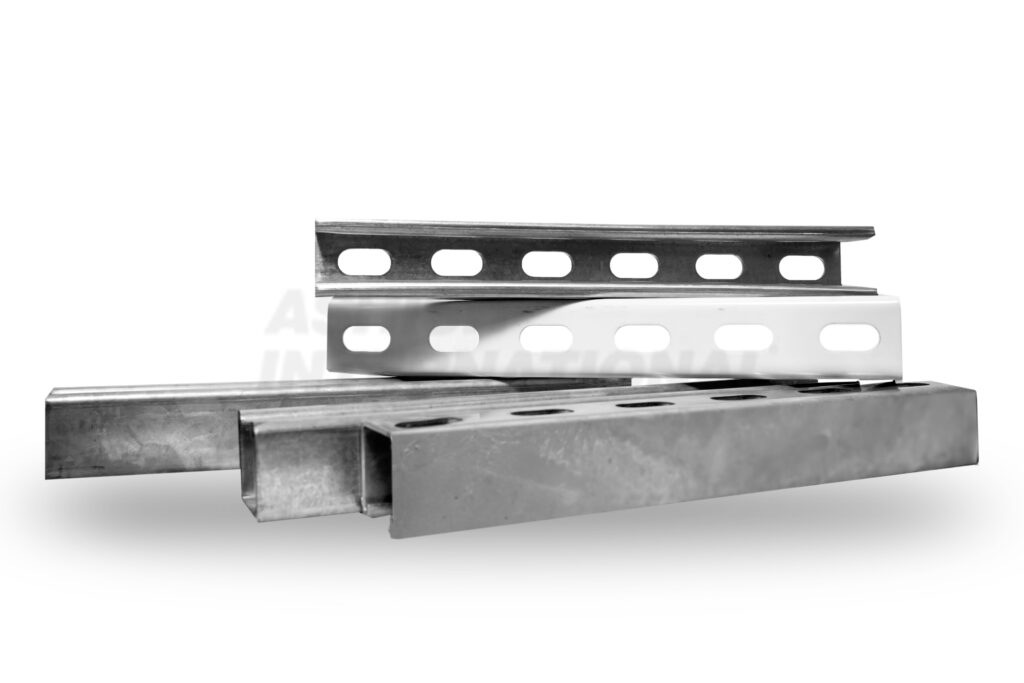
At its core, a strut channel is a C-shaped or U-shaped metal profile with inward-curving lips, engineered to accept specialized fittings and fasteners. This design is key to its modularity.
- Profile: The iconic C-shape with internal lips allows for the insertion of channel nuts, which can be positioned anywhere along the channel’s length.
- Plain vs. Slotted: Plain channels offer maximum strength for a given profile, while slotted channels provide superior adjustability for connections and are ideal for securing pipes and conduits at various points.
- Materials: Durability is paramount. At Ashish International, we manufacture a comprehensive range from high-quality mild steel and stainless steel, ensuring longevity and resistance to environmental factors.
Common Applications in MEP and Construction
Strut channel is the backbone for Mechanical, Electrical, and Plumbing (MEP) installations. Its adaptability makes it indispensable for:
- Supporting electrical conduit, cable trays, and data cabling.
- Hanging HVAC ductwork and ventilation systems.
- Securing plumbing pipes and process piping.
- Creating modular support frames, trapeze hangers, and ceiling grids.
Ashish International’s modular support system is designed to simplify these complex MEP frameworks, offering engineers flexible, load-bearing solutions adaptable to any project size.
As a leader in MEP Structure Solutions, Ashish International has over 25 years of experience providing the high-quality strut systems that modern construction demands.
Key Factors Determining How Much Weight Can Strut Channel Support
Material and Gauge: Steel Thickness Matters
The material’s thickness, or gauge, is a primary strength factor. In steel, a lower gauge number signifies a thicker, stronger product. For instance, a 12-gauge channel is significantly stronger than a 14-gauge channel of the same profile. The type of steel, such as mild steel for general use or stainless steel for corrosive environments, also affects overall performance. Ashish International’s commitment to using high-grade raw materials is the first step in guaranteeing a reliable strut support system.Channel Profile and Dimensions (e.g., 41×41 vs. 41×21)
The cross-sectional shape and size of the channel dictate its resistance to bending (flexural strength). Deeper profiles can handle heavier loads over longer spans.| Profile Type | Typical Dimensions | Primary Advantage |
| Standard/Deep Channel | 1-5/8″ x 1-5/8″ (41x41mm) | Higher load capacity and greater rigidity, ideal for heavy loads and longer spans. |
| Shallow Channel | 13/16″ x 1-5/8″ (21x41mm) | Lighter weight and suitable for low-profile applications or lighter loads. |
| Back-to-Back Channel | Two channels welded together | Significantly increases load capacity and resistance to twisting (torsional strength). |
Span Length: The Critical Distance Between Supports
This is arguably the most critical factor. The longer the distance (span) between support points, the lower the channel’s weight capacity. Think of it like a wooden plank — it’s much easier to bend a long plank in the middle than a short one. Careful planning of support locations based on the expected load is non-negotiable for determining how much weight a strut channel can support.How to Read Load Tables to Find How Much Weight Can Strut Channel Support
Decoding Manufacturer Load Charts
Reputable manufacturers like Ashish International provide detailed load tables for their products. These charts are the most accurate source of information for understanding how much weight a strut channel can support. Here’s how to read them:- Find the Span: Locate the column for the distance between your supports.
- Check the Uniform Load: This column shows the maximum allowable load (in kg or lbs) that can be distributed evenly across that span.
- Note the Deflection: This indicates how much the channel will bend under the maximum load. Excessive deflection can be an issue in some applications.
- Apply a Safety Factor: Always design your system with a safety margin. Never load a channel to its absolute maximum listed capacity.
Understanding Different Load Types (Uniform vs. Concentrated)
How the weight is applied dramatically affects the channel’s capacity.
Load Type | Description | Impact on Capacity |
Uniform Load | Weight is distributed evenly along the channel’s length, like a fully loaded cable tray. | Channels can support the highest total weight under this condition. Load tables are typically based on uniform loads. |
Concentrated Load | Weight is applied at a single point, like a heavy piece of equipment hanging from one spot. | The channel’s capacity is significantly reduced. A concentrated load at the center of a span is roughly half the capacity of a uniform load. |
Beyond the Channel: How Strong is a Strut Channel System?
The Critical Role of High-Quality Fittings and Fasteners
The integrity of your installation relies on using correctly rated and manufactured fittings. Inferior nuts, bolts, or brackets can fail long before the channel itself reaches its load limit. Ashish International manufactures a comprehensive ecosystem of products designed to work seamlessly together, including:- Channel Spring Nuts
- Channel Brackets (L, T, Z, U, etc.)
- Pipe Clamps & Hangers
- Cantilever Arms
- Beam Clamps
- Industrial Fasteners
Practical Load Scenarios to Determine How Much Weight Can Strut Channel Support
Example: Supporting Heavy-Duty Cable Trays and Pipe Racks
Scenario: You need to support a pipe rack weighing 300kg over a 1.5-meter span. Thought Process:- Consult Load Data: You would check the manufacturer’s load table for a 1.5m span. A shallow 21x41mm channel would likely be insufficient. You would look at a deep 41x41mm channel, probably in a heavy 12-gauge steel.
- Verify Capacity: The load table for the 41x41mm, 12-gauge channel must show a maximum uniform load capacity well above 300kg for a 1.5m span to provide a safety factor.
- Select Components: You would then select the appropriate supports, such as heavy-duty Cantilever Arms or Beam Clamps from Ashish International, and secure the pipes with correctly sized pipe clamp supports.
Why Choose Ashish International for Your Strut Support Systems
Custom Manufacturing and Global Expertise
With over 25 years of experience, robust production infrastructure, and stringent quality control, Ashish International delivers performance you can trust.- OEM/ODM Capabilities: We provide custom-built, quality-assured solutions tailored to your specific project requirements.
- Comprehensive Product Range: From strut channels to the smallest fasteners, we are your single source for complete MEP support systems.
- Global Reach: We export our products to demanding markets in Europe, the USA, the UK, the Middle East, and beyond, backed by complete export support services.
The vast range of applications has led to the development of many different types of pipe clamps. Choosing the right one is essential for optimal performance. The primary pipe clamp function remains the same, but the design is tailored to the need.
Frequently Asked Questions
Q1. How strong are strut channels?
Their strength varies greatly based on material thickness (gauge), profile depth, and the span between supports.
Q2. How much weight can a strut nut hold?
A standard channel nut’s capacity depends on its design and the channel it’s used in, but it is generally designed to handle significant pull-out and slip loads specified by the manufacturer.
Q3. How do you calculate strut channel load?
You don’t calculate it manually; you must refer to the manufacturer’s published load tables, which provide certified data for specific spans and load types.
Q4. What is the difference between plain and slotted strut channel for load-bearing?
For the same gauge and profile, a plain (solid) channel is slightly stronger as it has more material, while a slotted channel offers greater installation flexibility.
Q5. Does the finish (e.g., pre-galvanized vs. hot-dip galvanized) affect the strength of a strut channel?
The finish primarily affects corrosion resistance, not the inherent structural strength of the steel channel itself.
Q6. Can I get custom-length strut channels from Ashish International?
Yes, Ashish International offers OEM/ODM and custom manufacturing services to provide products tailored to your specific project needs.

Meet Kriti Mittal, the brand storyteller at Ashish International, a global leader in sheet metal components and industrial fasteners. She specialises in turning technical expertise into engaging stories that highlight the company’s precision, quality, and product innovations. Passionate about manufacturing trends and clear communication, she connects global industries with Ashish International’s vision of performance, trust, and reliability.
Connect With Us
Response within 24 hours, guaranteed.
Connect With Us
Response within 24 hours, guaranteed.

Ashish International
Online
Hi, there,
Welcome to the Ashish International Website!
How can we assist you today?
Start Chat
Online | Privacy policy