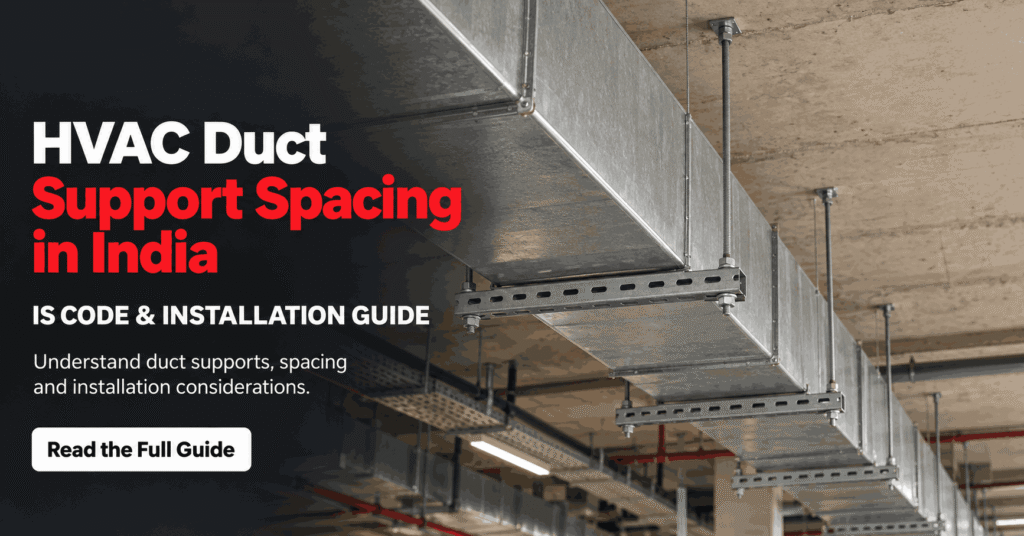
HVAC duct support spacing in India follows IS code practice and the widely adopted SMACNA standard, which set how far apart duct hangers should sit so ductwork does not sag, leak air, or vibrate. As a general rule, rectangular duct is supported every 2.5 to 3 metres, with lighter runs at wider intervals and heavy or large ducts held closer. The hanger size itself grows with the duct: a duct up to 750 mm wide typically uses a 25×25×3 mm angle with 6 mm rod, while a duct over 2400 mm needs a 50×50×6 mm angle with 10 mm rod. Ducts up to about 500 mm can hang on strap hangers; anything larger uses angle-and-rod or trapeze supports. Spacing tightens for insulated, large, or vibration-prone runs. Ashish International, with 25+ years in MEP supports, manufactures duct support strut channel, rod, and fixings to these standards, and this guide sets out the intervals and sizes.
Why Duct Support Differs From Pipe Support
Ducts and pipes both need support, but a duct is a different problem because it is large, light for its size, and thin-walled, so it behaves nothing like a solid pipe. A wide sheet-metal duct can flex, drum, and buckle under its own weight if hangers sit too far apart, and any sag opens joints that leak conditioned air and waste energy. Because a duct’s load is spread over a big surface rather than a small diameter, support is sized by the duct’s width and perimeter, not by a single pipe size. Large ducts also carry more air pressure and vibration, which loosens weak supports over time. This is why duct spacing rules key off duct dimensions and why big ducts move from simple strap hangers to trapeze supports. Size duct support to width and weight rather than treating it like a pipe, and ductwork stays tight and quiet.
Duct Support Spacing at a Glance
The table below gives typical maximum spacing and matched hanger sizes for rectangular duct, based on SMACNA practice as commonly applied on Indian projects.
| Duct width | Max spacing | Angle size | Rod size |
|---|---|---|---|
| Up to 750 mm | ~3000 mm | 25×25×3 mm | 6 mm |
| 751–1050 mm | ~3000 mm | 40×40×3 mm | 6 mm |
| 1051–1500 mm | ~3000 mm | 40×40×3 mm | 10 mm |
| 1501–2100 mm | ~2500 mm | 50×50×3 mm | 10 mm |
| 2101–2400 mm | ~2500 mm | 50×50×5 mm | 10 mm |
| Over 2400 mm | ~2500 mm | 50×50×6 mm | 10 mm |
Two clear patterns run through the table: spacing tightens from 3000 mm to 2500 mm once a duct passes 1500 mm wide, and both the angle and rod get heavier as the duct grows. Read spacing and hanger size together from the duct width and a compliant support layout starts there.
How Hanger Size Follows Duct Size
Choosing the right hanger is a short, ordered check that follows directly from the duct’s dimensions:
-
Measure the duct width: this sets both the spacing and the hanger size band.
-
Pick strap or trapeze: ducts up to ~500 mm can use strap hangers; larger ducts need angle-and-rod or a trapeze support.
-
Match the angle and rod: take the angle and threaded rod size from the table for that width.
-
Set the spacing: use ~3000 mm up to 1500 mm wide, ~2500 mm above that.
-
Fix to the structure: hang from beam clamps on steel or anchor bolts in concrete.
Moving from strap to trapeze is the step most often skipped. A large duct on a light strap hanger sags and drums. Size the hanger straight from the duct width and the support stays both compliant and strong.
What Makes Duct Spacing Tighter
The table is a baseline, and several real-world factors shorten the safe interval. Watch for these:
-
Insulation weight: external insulation adds load the hangers must carry.
-
Large or heavy sections: wide, long, or lined ducts sag sooner and need closer support.
-
Vibration and pressure: high-velocity or plant-room ducts need vibration isolators and firmer support.
-
Vertical duct runs: risers are supported at each floor, not at the horizontal interval.
-
Fittings and dampers: elbows, transitions, and dampers add weight that needs its own support.
Insulation is the factor most often forgotten, quietly adding load to every hanger on a run. Adjust the interval for weight, vibration, and fittings and a table figure becomes a safe real-world layout.
Choosing the Right Support Material
Beyond size and spacing, the support material must suit the environment, because a duct system is meant to last decades. For most indoor air-conditioning ducts, pre-galvanised or hot dip galvanised steel angle, channel, and rod are the standard, giving good corrosion life at reasonable cost. For humid, coastal, or wet plant rooms, stainless steel supports resist rust where galvanised steel would eventually corrode. Whatever the finish, every part of a hanger, including angle, rod, nuts, and pipe clamps where used, should share the same corrosion grade, since a plain nut on a galvanised rod rusts first and weakens the whole support. Match the support material to the building’s environment and duct hangers stay sound for the system’s full life.
Duct Supports Made to a Consistent Standard
Duct runs use the same hanger sizes hundreds of times over, so consistency across every piece is what keeps a whole system compliant and quick to install. That is where three decades of manufacturing tell: Ashish International runs three units over 60,000 square feet at 350 tonnes a month under in-house quality control, so angle, channel, and rod arrive to consistent, matched dimensions run after run. HVAC contractors, stockists, and sourcing companies across the UK, Europe, the Middle-East, Australia, and Africa specify us for that repeatability, and several have partnered with us for over 20 years, some under NDA for their own designs. We manufacture to the SMACNA and dimensional standards global specifiers use, and for brands and MNCs we run the full range as white-label, your spec, your branding, with FITSTRUTS® as a stock option. For full spacing charts, load data, or a white-label discussion, call +91-99888-54380 or email ashishint2001@gmail.com.
1. What is the correct HVAC duct support spacing in India?
Following IS code practice and SMACNA, rectangular duct is generally supported every 2.5 to 3 metres, about 3000 mm for ducts up to 1500 mm wide and 2500 mm for wider ducts. Spacing tightens for insulated, large, or vibration-prone runs, and vertical ducts are supported at each floor.
2. What size hanger do I need for HVAC duct?
Hanger size grows with duct width. A duct up to 750 mm typically uses a 25×25×3 mm angle with 6 mm rod, while a duct over 2400 mm needs a 50×50×6 mm angle with 10 mm rod. Ducts up to about 500 mm can use strap hangers; larger ducts use angle-and-rod or trapeze supports.
3. When should I use a trapeze support instead of a strap hanger?
Strap hangers suit ducts up to about 500 mm wide. Larger, heavier, or insulated ducts should use angle-and-rod or trapeze supports, because a light strap hanger on a big duct lets it sag and drum, opening joints and leaking conditioned air.
4. Does duct insulation affect hanger spacing?
Yes. External insulation adds weight to every hanger on the run, so an insulated duct can need closer support than a bare one of the same size. Always base spacing on the finished, insulated weight rather than the bare duct alone.
5. Do you supply matched duct hanger angle, channel and rod together?
Yes. We manufacture duct support angle, channel, rod, and fixings to consistent, compatible dimensions, so a whole run’s hangers match. This is available on standard and white-label orders for HVAC contractors, stockists, and sourcing partners, with proprietary work under NDA.