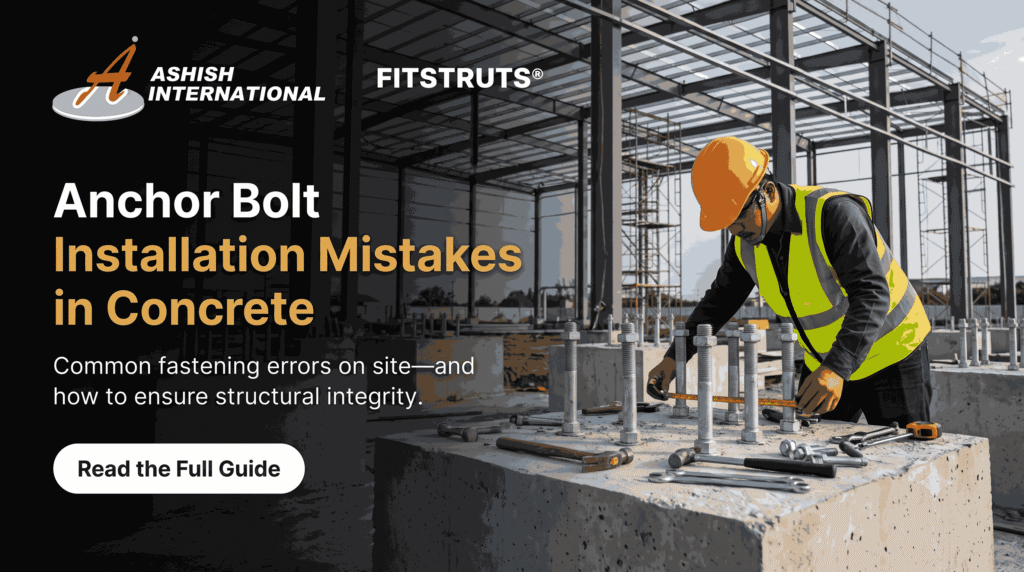
The most common anchor bolt installation mistakes in concrete are a dirty drill hole, wrong embedment depth, over- or under-tightening the bolt, and setting it too close to an edge. Any one of these can cut a bolt’s holding power by half or more, even when the bolt itself is the right size and grade. A hole left full of drilling dust is the single biggest cause of anchor bolt pull-out, because the dust stops the bolt or adhesive gripping the concrete. Getting the torque wrong comes next: too little and the bolt never sets; too much and it strips the concrete or snaps. A strong bolt fails when it is installed carelessly. Ashish International, with 25+ years in industrial fasteners, supplies anchor bolts with clear installation data, and this guide covers the mistakes that cause failure and how to avoid each one.
26+
25+
< 12 hr
Have a Requirement in Mind?
The Seven Mistakes That Cause Most Failures
Nearly every anchor failure traces back to a short list of avoidable errors. Ranked by how often they cause trouble on site:
- Not cleaning the hole — drilling dust left in the hole is the top cause of pull-out; the bolt grips dust, not concrete.
- Wrong hole diameter — too wide and the bolt cannot expand or bond properly.
- Shallow embedment — a bolt set too shallow loses most of its pull-out strength.
- Bad edge distance — set too near an edge, the concrete breaks out in a cone before the bolt fails.
- Wrong torque — under-tightening leaves it loose; over-tightening strips or snaps it.
- Ignoring cracked concrete — using non-cracked load figures where the concrete is cracked over-estimates capacity.
- Mismatched fastener — using the wrong anchor type for the base material or load.
That first mistake alone accounts for a large share of field failures, and it takes seconds to fix with a blow pump and brush. Knowing these seven is the starting point for a fixing that holds for its full design life.
Why a Correctly Sized Bolt Still Pulls Out
It surprises many people that a bolt of the right size and grade can still fail, but installation, not specification, is usually to blame. When an anchor bolt pulls out, the concrete around it has given way rather than the steel breaking and that almost always comes from a dirty hole, shallow embedment, or an edge too close. A hole full of dust can lose a major share of its rated pull-out strength, because the bond or expansion never fully engages. Shallow embedment has the same effect, since pull-out resistance depends heavily on how deep the bolt sits. This is why our wedge anchor and foundation and anchor bolts ship with embedment and hole-size data printed clearly. Once you see that failure usually starts in the concrete, not the bolt, attention shifts to careful installation.
26+
25+
< 12 hr
Have a Requirement in Mind?
Getting the Torque Right
Torque is where good bolts are quietly ruined, because both too little and too much cause failure. Each bolt size has a recommended installation torque, and staying near it is what lets the bolt set correctly without damaging the concrete. The table below gives typical recommended torque ranges for common sizes.
Size | Typical torque | What goes wrong if ignored |
M8 | ~20 Nm | Loose set or stripped thread |
M10 | ~40 Nm | Under-torque leaves it loose |
M12 | ~60 Nm | Over-torque cracks the concrete |
M16 | ~80 Nm | Snapped bolt or spalled concrete |
M20 | ~150 Nm+ | Severe over-torque splits the slab |
The safest practice is a calibrated torque wrench, not a feel-based tighten with an impact gun, which is a common way to over-torque without realising. These are general figures always follow the exact torque for your specific wedge anchor fastener or pin-type anchor. Torque to spec rather than by feel and a bolt stays tight without breaking what holds it.
The Cracked-Concrete Trap
One error deserves its own mention because it hides in the paperwork, not the workmanship. Load tables usually quote figures for non-cracked concrete, but slab edges, tension zones, and seismic areas are often cracked and there the same bolt holds noticeably less, sometimes a third lower. Using a non-cracked figure in cracked concrete looks fine on paper yet leaves a fixing badly under-strength. Confirm the concrete condition and use the matching load column before finalising a size.
How to Install an Anchor Bolt That Holds
Avoiding failure is mostly about a few disciplined habits, and none of them are difficult:
- Clean the hole properly — blow out dust, brush the walls, and blow again before setting the bolt.
- Drill the right hole — match the drill diameter and depth to the bolt’s data sheet.
- Hit the embedment — set the bolt to the full stated depth, not just flush.
- Respect edge and spacing — keep clear of edges and other bolts per the load table.
- Torque to spec — use a calibrated wrench and the recommended value for the size.
These steps take minutes and cost nothing, yet they separate a fixing that holds for decades from one that pulls out under load. The same discipline underpins the reliable MEP support structures and threaded rod fixings we supply. Install with care rather than just quickly, and an anchor becomes genuinely dependable.
26+
25+
< 12 hr
Have a Requirement in Mind?
Bolts and Data That Set Installers Up to Succeed
Half of a good fixing is the installer’s care the other half is a bolt made right, with the data to install it correctly. That is what 25+ years of fastener manufacturing delivers: Ashish International runs three units over 60,000 square feet at 350 tonnes a month under in-house quality control, shipping anchors with clear embedment, hole-size, and torque data so crews avoid the mistakes above from the start. Contractors, stockists, and sourcing companies across the UK, Europe, the Middle-East, Australia, and Africa rely on that consistency, and several have partnered with us for over 20 years, some under NDA for their own designs. We manufacture anchors and industrial fasteners to the standards global specifiers expect, and for brands and MNCs we run the full range as white-label your spec, your branding, with FITSTRUTS® as a stock option. For installation data, load tables, or a white-label discussion, call +91-99888-54380 or email ashishint2001@gmail.com.
Frequently Asked Questions
Q1. What are the most common anchor bolt installation mistakes in concrete?
Common anchor bolt installation mistakes include leaving drilling dust inside the hole, using the wrong hole diameter, providing insufficient embedment depth, installing anchors too close to concrete edges, and applying incorrect tightening torque. These errors can significantly reduce the anchor’s load capacity and compromise the fixing, even when the correct anchor type has been selected. Following the manufacturer’s installation instructions is essential for reliable performance.
Q2. Why does an anchor bolt pull out of concrete?
An anchor bolt can pull out when the anchoring mechanism or surrounding concrete cannot resist the applied load. Common causes include insufficient embedment, inadequate hole cleaning, incorrect installation torque, and insufficient edge distance. Excessive loading or weak concrete can also cause concrete breakout around the anchor. Correct anchor selection and installation help reduce the risk of failure.
Q3. How much should I torque an anchor bolt?
The recommended tightening torque depends on the anchor type, diameter, material, and installation requirements. Values such as 20 Nm for M8, 40 Nm for M10, 60 Nm for M12, and 80 Nm for M16 may apply to certain anchors, but they should not be treated as universal specifications. Always follow the manufacturer’s technical data and use a calibrated torque wrench where specified, as both under-tightening and over-tightening can affect anchor performance.
Q4. Does cleaning the drill hole really matter?
Yes. Proper hole cleaning is essential for many concrete anchoring systems, particularly adhesive anchors and mechanical anchors that require clean holes for correct installation. Dust and drilling debris can interfere with bonding or prevent the anchor from engaging as intended. Follow the manufacturer’s prescribed cleaning procedure, which may involve blowing out dust, brushing the hole, and blowing it out again using the specified tools.
Q5. Do your anchor bolts include the installation data crews need?
Ashish International can provide relevant technical information for supplied anchors, including recommended hole dimensions, embedment depths, and tightening torque where applicable. This helps installation teams follow the specified installation procedure and reduce common fixing errors. We also manufacture products to customer drawings and specifications, with white-label supply available for brands, stockists, and sourcing partners. Proprietary designs can be handled under NDA where required.

Meet Kriti Mittal, the brand storyteller at Ashish International, a global leader in sheet metal components and industrial fasteners. She specialises in turning technical expertise into engaging stories that highlight the company’s precision, quality, and product innovations. Passionate about manufacturing trends and clear communication, she connects global industries with Ashish International’s vision of performance, trust, and reliability.