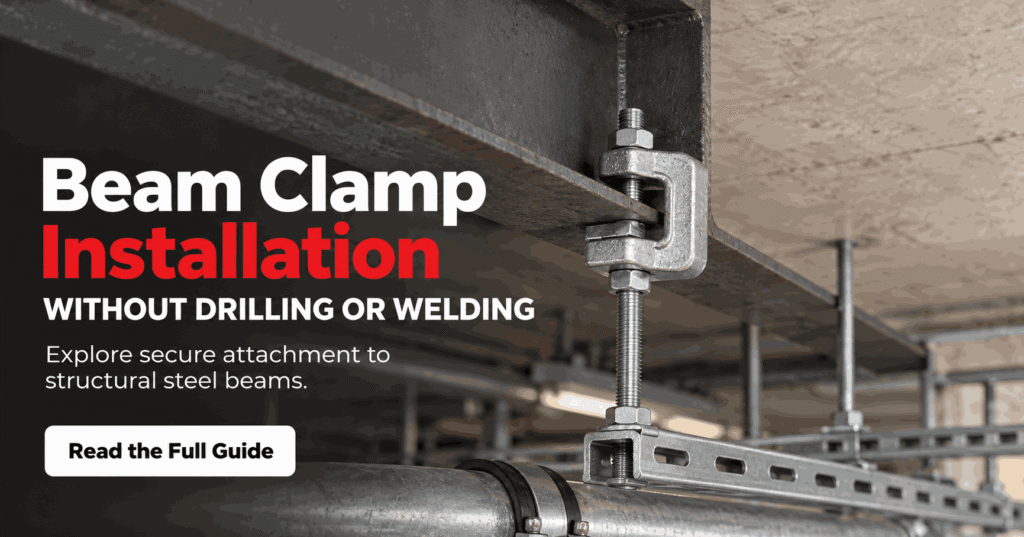
Beam clamp installation without drilling or welding is the fastest, cleanest way to hang pipe, cable, or duct support from a steel beam. You simply clamp onto the beam flange and tighten. A beam clamp grips the edge of the flange and is held by a set-screw or bolt, so the load transfers into the beam through the clamp’s jaw with no hole drilled and no weld made. This keeps the beam’s steel intact, avoids damaging its fireproofing or coating, and lets a fixing go up in minutes instead of the hours drilling or welding would take. It is the standard method for hanging services from structural steel in factories, warehouses, and retrofit jobs. Ashish International, with 25+ years manufacturing MEP supports, produces beam clamps rated for these fixings, and this guide shows how to install one correctly and safely.
Why No-Drill, No-Weld Fixing Matters
Clamping to a beam rather than drilling or welding it is not just faster, it protects the structure and the schedule. The reasons it is preferred:
Keeps the beam intact: no hole means no weakening of the steel section’s structural capacity.
Protects fireproofing and coating: drilling or welding damages intumescent coating and galvanising; clamping does not.
Fast and clean: a clamp goes on in minutes with hand tools, no hot work permit or drilling dust.
Reversible and adjustable: a clamp can be moved or removed, unlike a welded or drilled fixing.
Ideal for retrofit: services can be added to an existing steel frame without touching the structure.
Protecting the beam is the point that matters most on a structural member, because a drilled or welded hole can compromise steel that an engineer sized precisely. Clamp instead of cutting the beam, and you keep the structure sound while fixing fast.
How a Beam Clamp Grips the Steel
Understanding the grip explains why a clamp is trusted with real load. A beam clamp is shaped to hook over the flange of a steel beam, an I-beam, purlin, or channel, with a jaw that sits on the flange edge. A set-screw or through-bolt is then tightened, pulling the clamp firmly against the flange so friction and the jaw’s shape lock it in place. The load, a pipe, a trapeze, or a threaded rod drop, hangs from the clamp’s eye or thread, transferring straight into the beam. Because the grip depends on the clamp matching the flange thickness, choosing the right clamp for the beam is essential. The clamp holds by clamping force on the flange, not by any hole, which is exactly what makes it drill-free.
How to Install a Beam Clamp, Step by Step
Fitting a beam clamp is quick, but a few checks make the fixing safe. Follow these steps:
Match the clamp to the flange: pick a clamp rated for the beam’s flange thickness and the load.
Position it on the flange: hook the clamp over the flange edge where the support is needed.
Seat it square: make sure the jaw sits fully and squarely on the flange, not on an angle.
Tighten the set-screw or bolt: tighten firmly so the clamp grips the flange without slipping.
Hang and load: attach the rod, trapeze, or hanger, and confirm the clamp stays tight under load.
Matching the clamp to the flange at step one is what most affects safety, because a clamp on the wrong flange thickness will not grip properly. Seat it square, tighten fully, and the fixing carries its rated load without a single hole.
Mistakes to Avoid With Beam Clamps
A beam clamp is reliable when used right, but a few errors undo it. Watch for these:
Wrong flange fit: a clamp that does not match the flange thickness grips poorly or slips.
Under-tightening: a loose set-screw lets the clamp shift under vibration or load.
Overloading: exceeding the clamp’s rated load can bend the jaw or let it release.
Sloping fixing: hanging a side load where the clamp is rated for straight-down pull can dislodge it.
Mixed metals: a plain-steel clamp on galvanised or stainless support rusts at the joint.
Overloading is the most dangerous, because a clamp pushed past its rating can release suddenly rather than sagging as a warning. Match the clamp, tighten it, and stay within its rated load, and it will hold as long as the structure it grips.
Where No-Drill Beam Fixing Fits Best
Beam clamps suit any job where drilling or welding structural steel is unwanted, slow, or not allowed. They are the go-to for retrofit work, adding pipe or cable support to an existing steel frame without disturbing it, and for pre-engineered buildings and warehouses where services hang from purlins and portal frames. They also suit fast-track projects where hot work permits and drilling would slow the programme, and areas where fireproofing must stay intact. In all of these, the clamp pairs with strut channel trapezes and pipe clamps to form a complete MEP support structure fixed entirely without holes. Choose beam clamps wherever the steel must stay untouched, and services go up fast without compromising the structure.
Clamps Rated to Grip and Hold
A beam clamp carries its whole load through a grip on a flange edge, so the clamp’s jaw strength, thread, and rating are what keep a fixing safe. Ashish International brings 25+ years across three units and 60,000 square feet, producing 350 tonnes of MEP support a month under in-house quality control, so clamps are made to consistent dimensions and dependable load ratings. MEP contractors, retrofit specialists, stockists, and sourcing companies across the UK, Europe, the Middle-East, Australia, and Africa rely on that consistency, and several have worked with us for over 20 years, some under NDA for their own designs. We manufacture beam clamps, channel, and matched fittings to the standards global specifiers expect, and for brands and MNCs we run the full range as white-label: your spec, your branding, with FITSTRUTS® where a stock line fits. For load data, samples, or a white-label discussion, call +91-99888-54380 or email ashishint2001@gmail.com.
1. How do you fix pipe support to a steel beam without drilling or welding?
Use a beam clamp: hook it over the beam’s flange edge and tighten its set-screw or bolt so it grips the flange. The load, a pipe, trapeze, or threaded rod, then hangs from the clamp and transfers into the beam, with no hole drilled and no weld made.
2. Why avoid drilling or welding a steel beam for supports?
Drilling a hole can weaken a beam that an engineer sized precisely, and both drilling and welding damage the beam’s fireproofing and coating. Clamping keeps the steel and its protection intact, is far faster, needs no hot-work permit, and can be moved or removed later.
3. How does a beam clamp hold without a hole?
A beam clamp hooks over the flange, and a tightened set-screw or bolt pulls its jaw firmly against the flange so friction and the jaw shape lock it in place. The load transfers through this grip into the beam, which is why choosing a clamp that matches the flange thickness is essential.
4. Are beam clamps suitable for retrofit work?
Yes, beam clamps are ideal for retrofit, because they add pipe, cable, or duct support to an existing steel frame without drilling or welding the structure. This makes them a fast, clean choice for warehouses, pre-engineered buildings, and any job where the steel must stay untouched.
5. Can you supply beam clamps rated for our beam and load?
Yes, we manufacture beam clamps sized to different flange thicknesses and load ratings, in galvanised and stainless finishes, so they grip and hold correctly. We produce to your drawings too, with white-label supply for contractors, stockists, and sourcing partners under NDA.