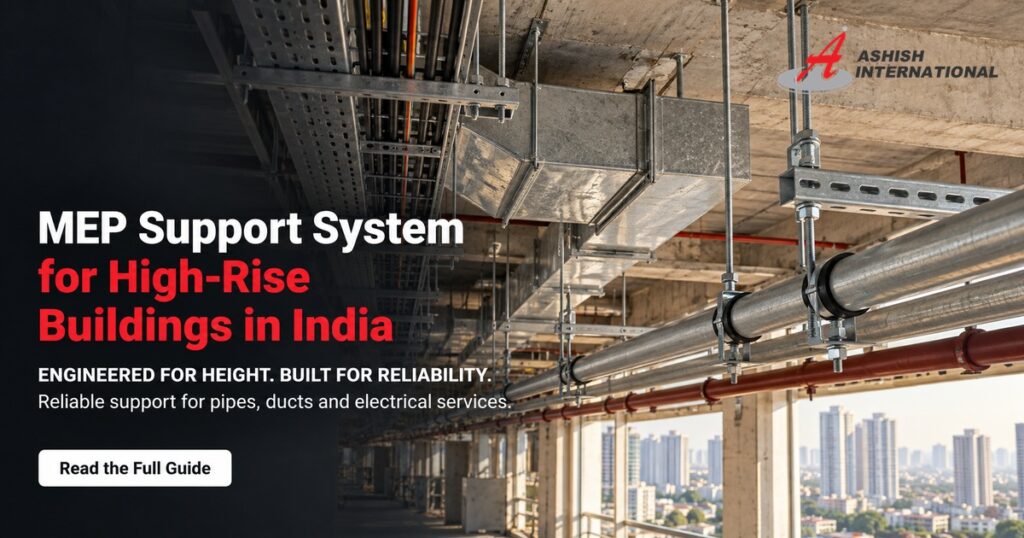
An MEP support system for a high-rise building in India is the network of channels, hangers, clamps, and brackets that supports the mechanical, electrical, and plumbing services running throughout the structure. In a high-rise, these supports must carry vertical pipe risers across multiple floors, accommodate building movement and thermal expansion, and handle the combined loads of long service runs. The main components include strut channels for framing, riser clamps for vertical pipes, trapeze hangers for grouped horizontal services, and rated anchor bolts for securing supports to the concrete structure.
Because accessing and repairing supports at height can be difficult and costly, every component must be correctly specified, corrosion-protected, and installed according to the applicable standards. Ashish International, with over 25 years of experience in MEP supports, manufactures a comprehensive range of MEP support structures for tall buildings. This guide explains the key considerations for high-rise MEP support systems.
Why High-Rise Support Is a Different Problem
Supporting services in a tall building involves more than scaling up a low-rise system. Building height introduces additional engineering considerations. A 30-storey riser can carry substantial weight, particularly when filled with water, and this load must be transferred safely to the building structure through appropriately designed supports. Tall buildings also experience movement due to wind and thermal expansion, so supports must accommodate the movement specified in the design without overstressing pipes or joints.
Long service runs can create heavier combined loads on trapeze and horizontal supports. Access is another concern: repairing a failed support on the 25th floor can be expensive and difficult once the building is operational. High-rise support systems therefore require careful load calculations, suitable component selection, and proper installation rather than simply using a larger version of a low-rise arrangement.
The Main Challenges to Design For
A high-rise support system must address several requirements simultaneously. Overlooking any of them can create problems during installation or throughout the building’s service life.
Vertical riser loads: Tall, water-filled risers can impose substantial loads that must be transferred to the structure through an engineered support arrangement.
Building movement: Wind-induced sway and thermal expansion require supports that accommodate the movement anticipated in the design.
Heavy combined loads: Long horizontal service runs may group multiple pipes, ducts, and other services on shared trapeze supports.
Corrosion over decades: Materials and protective finishes must suit the building’s environment and expected service life.
Fire and seismic requirements: Applicable codes may require specific support arrangements, restraints, and bracing for life-safety systems and other services.
Riser loads deserve particular attention because the weight of a tall vertical pipe can be substantial. The support arrangement must establish a clear load path and distribute forces according to the engineered design. Considering these requirements together helps create a dependable high-rise MEP support system.
The Building Blocks of a High-Rise Support System
A complete system uses compatible components, each designed for a specific supporting function.
Strut channel: The main framing component for trapezes, wall supports, and service-support structures. Single or back-to-back strut channel configurations may be used where the engineered design requires additional capacity or stiffness.
Riser clamps: Riser clamps support vertical pipes through a suitable connection to the building structure.
Trapeze hangers: These group multiple horizontal pipes or services onto a shared support, often using threaded rods.
Pipe clamps and hangers: Pipe clamps and pipe hangers secure individual lines at intervals specified by the design.
Anchors and fixings: Rated anchor bolts connect support assemblies to the concrete structure and transfer the applicable loads.
Anchors are an important part of the complete load path because forces from pipes, trapezes, and framing must ultimately be transferred to the supporting structure. Component selection should account for the expected loads, substrate, connection details, environmental conditions, and relevant manufacturer specifications.
How Support Works Floor by Floor
A defining consideration in high-rise support design is how vertical loads are transferred through the building. Vertical risers require an engineered arrangement of supports and connections that accounts for the pipe’s weight, contents, thermal movement, and the capacity of the supporting structure. Horizontal services on each floor are typically carried by trapeze hangers, pipe hangers, or channel-support assemblies connected to suitable structural points.
Distributing Riser Loads Safely
The load imposed by a tall or heavy riser can be significant, so the design must verify the capacity of the clamps, connections, slabs, and other supporting elements. The required support locations and spacing depend on the pipe system, materials, dimensions, operating conditions, and engineered design. Additional supports or stronger components may be necessary where the calculated loads require them.
A floor-by-floor arrangement should not automatically be assumed to divide the riser’s weight equally. The actual load distribution depends on the support configuration and how the pipe is anchored, guided, and allowed to move. Establishing and checking the complete load path helps prevent individual components or structural connections from being overloaded. For more information, explore pipe clamp support systems.
Matching Supports to High-Rise Services
Different services require different support arrangements. The following table outlines common approaches and the main considerations involved.
| Service | Typical support | Key concern |
|---|---|---|
| Water and drainage risers | Engineered riser clamps and supporting connections | Vertical loads and structural capacity |
| HVAC ducts and chilled-water pipes | Trapeze hangers and channel supports | Combined weight, span, and movement |
| Fire-fighting pipes | Designed pipe supports and required bracing | Applicable fire-safety and seismic requirements |
| Electrical cables and containment | Trapeze or channel-support assemblies | Routing, loading, and maintenance access |
| Rooftop plant and tanks | Engineered support frames | Equipment loads, wind exposure, and structural capacity |
Vertical services generally require carefully designed riser support arrangements, while horizontal services often use trapezes, hangers, or channel framing. Both must connect to suitable structural points through appropriately rated fixings.
Ashish International manufactures strut channels and related support components for a range of MEP applications. The final selection of components, support spacing, and connections should be based on project requirements, verified load capacities, and applicable codes and standards.
Engineered for the Buildings That Can’t Afford Failure
In a high-rise building, supports can become difficult to access once the services are installed and operational. Getting the specifications and installation right from the beginning is therefore essential.
Ashish International brings over 25 years of manufacturing experience, operating three manufacturing units across more than 60,000 square feet, with a stated production capacity of 350 tonnes per month and in-house quality control. The company supplies MEP support components to developers, MEP contractors, stockists, and sourcing companies serving projects across the UK, Europe, the Middle East, Australia, and Africa.
Some customers have partnered with the company for more than 20 years, including businesses that source products under non-disclosure agreements for their own designs. Ashish International also offers white-label manufacturing for brands and multinational companies, producing components to agreed specifications and branding requirements, including its FITSTRUTS® stock range where suitable.
For product information, technical specifications, or white-label manufacturing enquiries, call +91-99888-54380 or email ashishint2001@gmail.com.
Q1. What is an MEP support system in a high-rise building?
An MEP support system is the network of strut channels, riser clamps, trapeze hangers, pipe clamps, and anchor bolts that supports mechanical, electrical, and plumbing services throughout a tall building. It provides support for vertical risers and horizontal service runs while transferring loads to the building structure.
Q2. Why do high-rise buildings need specialised MEP supports?
High-rise buildings involve substantial vertical pipe loads, wind-induced movement, thermal expansion, and potentially heavy combined loads from long service runs. Their support systems must be designed for these conditions, with suitable corrosion protection, verified component capacities, and installation that meets applicable requirements.
Q3. How are vertical pipe risers supported in a high-rise?
Vertical risers use an engineered combination of riser clamps, anchors, guides, and structural connections. The support locations and load distribution depend on the pipe system and design. Each supporting element and structural connection must be checked to ensure it can safely carry the loads assigned to it.
Q4. What components make up a high-rise MEP support system?
Common components include strut channels for framing, riser clamps for vertical pipes, trapeze hangers and threaded rods for horizontal service runs, pipe clamps and hangers for individual lines, and rated anchor bolts for structural connections. The exact combination depends on the services and project requirements.
Q5. Can Ashish International supply a complete high-rise support package to project specifications?
Ashish International manufactures a range of MEP support components and offers production to agreed project specifications. Its capabilities also include white-label manufacturing for brands, stockists, and sourcing partners, with non-disclosure arrangements available for proprietary designs where agreed. Contact the company to discuss product requirements and technical specifications.