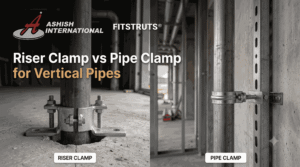
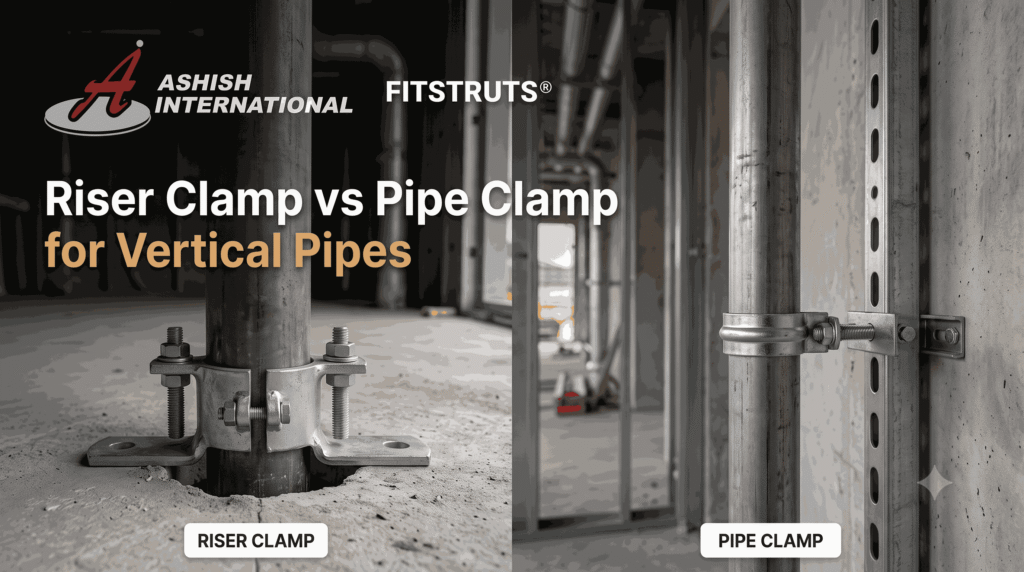
In the choice of riser clamp vs pipe clamp for vertical pipe, the riser clamp is the correct one: a standard pipe clamp is built for horizontal runs and will slip under a vertical load. A riser clamp wraps around a vertical pipe and rests its two arms on a floor slab or structural steel at each floor penetration, so the pipe’s full weight transfers safely to the building. A standard pipe clamp or U-bolt holds a pipe sideways by friction alone and is not rated to carry weight along the pipe’s axis, so on a riser it can slowly slide until the whole run drops onto the bend below. Use a riser clamp for any vertical pipe, and a pipe clamp for horizontal runs. Ashish International, with 25+ years in MEP supports, manufactures both riser clamps and pipe clamps to international standards, and this guide explains exactly when to use each.
26+
25+
< 12 hr
Have a Requirement in Mind?
The Core Difference in One Idea
The whole distinction comes down to the direction of the load, and getting this one idea right prevents the most dangerous support failure in plumbing. A horizontal pipe pushes down on its support, so a standard clamp holding it from above or the side works well. A vertical pipe pushes along its own length, straight down through itself, which no sideways clamp can hold by friction for long. A riser clamp is designed for exactly this axial load: its arms sit on a solid surface and carry the pipe’s weight in compression, not friction. Using a horizontal clamp on a vertical pipe is the single most common, and most hazardous, mistake in pipe support, because it fails slowly and then all at once. Once you see that load direction, not pipe size, decides the clamp, every correct choice follows.
Riser Clamp vs Pipe Clamp, Side by Side
The two devices look similar but do very different jobs. The table below sets out how they compare for vertical pipe support.
| Feature | Riser Clamp | Standard Pipe Clamp |
|---|---|---|
| Load direction | Vertical / axial | Horizontal / lateral |
| How it holds | Arms rest on slab or steel | Friction around the pipe |
| Where it sits | At floor penetrations | Along horizontal runs |
| Rated for riser weight | Yes | No, will slip |
| Typical use | Multi-floor risers | Horizontal mains and branches |
| Failure risk if misused | None when correctly specified | Pipe slides and drops |
The decisive row is “rated for riser weight”: a standard clamp simply is not, which is why it should never carry a vertical run. Read this comparison first and the choice is settled before any sizing begins.
When to Use Each One
Matching the clamp to the run is straightforward once load direction is clear. Use each where it belongs:
- Use a riser clamp: on any vertical pipe passing through floors, especially heavy water-filled or cast-iron risers in multi-floor buildings.
- Use a pipe clamp: on horizontal mains, branches, and short runs where the load presses down on the support.
- Support cast iron more often: heavier pipe materials need closer support intervals on the riser.
- Distribute tall risers: a very tall or heavy riser may need clamps at several floors so no single slab is overloaded.
The clearest rule for a vertical pipe support in India is simple: if the pipe goes up through a floor, it needs a riser clamp, not a pipe clamp. Choose by load direction rather than habit, and a riser stays safe for the life of the building.
26+
25+
< 12 hr
Have a Requirement in Mind?
How a Riser Clamp Actually Carries the Load
Understanding the mechanism explains why the riser clamp is trusted for heavy vertical runs. The clamp is fitted around the pipe and its bolts tightened so the inner surface grips firmly: full surface-to-surface contact is what stops slippage, which is why set-screw-only clamps are not used on risers. The two arms then extend past the floor opening and rest on the slab, transferring the pipe’s weight straight into the structure in compression. For very heavy risers, shear lugs are sometimes welded to the pipe so the load bears on them rather than on friction alone.
Two-Bolt vs Yoke Clamps
There are two common riser clamp types, and the choice depends on load. A two-bolt riser clamp suits standard vertical runs and is the everyday choice. A yoke clamp carries a greater load and keeps a lower profile below the pipe, which helps where clearance is tight. For the heaviest risers, the yoke design is the safer specification. Match the clamp type to the riser’s weight and the arms and bolts are never over-stressed.
How to Specify the Right Support
Selecting the correct clamp is a short, ordered check. Work through it in this order:
- Identify the run: vertical or horizontal decides riser clamp or pipe clamp.
- Size to the pipe: match the clamp to the exact pipe outer diameter.
- Account for the contents: water-filled and cast-iron pipe are far heavier than empty.
- Set the intervals: support the riser at each floor, more often for heavy material.
- Match the finish: galvanised or stainless to suit the environment, with matched threaded rod and fixings.
Get step one right and it prevents the dangerous mistake of a pipe clamp on a riser, where most vertical-support failures begin. These clamps work alongside strut channel, pipe hangers, and beam clamps in a full support system. Specify by run type and pipe weight and a vertical support becomes genuinely reliable.
26+
25+
< 12 hr
Have a Requirement in Mind?
Clamps Rated for the Weight They Carry
A riser clamp holds a live, water-filled pipe several storeys tall, so its arms, bolts, and grip have to be made to a real rating, not just a shape. That is where manufacturing depth counts: Ashish International brings 25+ years across three units and 60,000 square feet, producing 350 tonnes of MEP support a month under in-house quality control, so every clamp performs to spec. Plumbing and MEP contractors, stockists, and sourcing companies across the UK, Europe, the Middle-East, Australia, and Africa buy from us for that assurance, and several have worked with us for over 20 years, some under NDA for their own designs. We make riser and pipe clamps to the dimensional and load standards global specifiers expect, and for brands and MNCs we run the full range as white-label: your spec, your branding, with FITSTRUTS® as a stock option. For load data, sizing charts, or a white-label discussion, call +91-99888-54380 or email ashishint2001@gmail.com.
Frequently Asked Questions
Q1. What is the difference between a riser clamp and a pipe clamp for vertical pipe?
A riser clamp is made for vertical pipe: its arms rest on a floor slab and carry the pipe’s weight downward into the structure. A standard pipe clamp holds a pipe by friction and is built for horizontal runs. Used on a vertical pipe, it can slip and let the run drop.
Q2. When should I use a riser clamp?
Use a riser clamp on any vertical pipe that passes through floors, especially heavy water-filled or cast-iron risers in multi-floor buildings. The clamp is fitted at each floor penetration so the pipe’s weight transfers safely to the slab or structural steel.
Q3. Why can't a standard pipe clamp support a vertical pipe?
A standard pipe clamp or U-bolt holds a pipe by friction and is not rated for axial (vertical) load. On a riser it can slowly slide under the pipe’s weight until the whole run crashes onto the bend below, which is a common cause of serious pipe failure.
Q4. What is the difference between a two-bolt and a yoke riser clamp?
A two-bolt riser clamp suits standard vertical runs and is the everyday choice, while a yoke clamp carries a greater load and sits lower below the pipe, helping where clearance is tight. Heavier risers usually call for the yoke design.
Q5. Do you supply riser clamps sized to specific pipe diameters?
Yes, we manufacture riser and pipe clamps to fit exact pipe outer diameters, in two-bolt and yoke types and in galvanised or stainless finishes. We also produce to your drawings, with white-label supply for stockists, brands, and sourcing partners under NDA.

Meet Kriti Mittal, the brand storyteller at Ashish International, a global leader in sheet metal components and industrial fasteners. She specialises in turning technical expertise into engaging stories that highlight the company’s precision, quality, and product innovations. Passionate about manufacturing trends and clear communication, she connects global industries with Ashish International’s vision of performance, trust, and reliability.