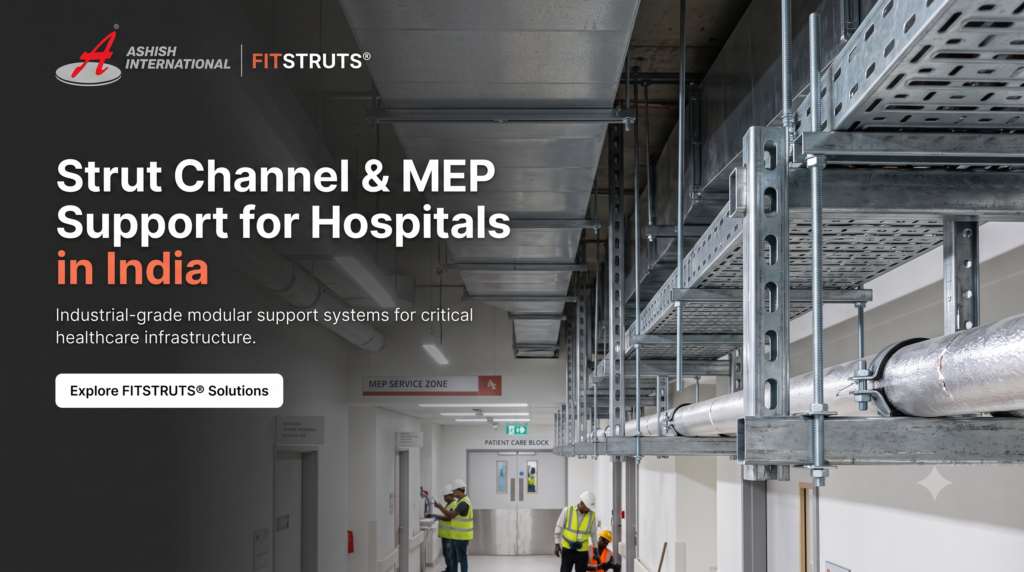
Strut channel and MEP support for a hospital building in India is the framing and fixing system that holds up the pipes, medical gas lines, cables, and ducts running through a healthcare facility built to keep them clean, secure, and safe during any emergency. A hospital is not an ordinary building: its supports must resist corrosion and infection risk, survive an earthquake so life-support services keep running, and carry critical systems like medical gas and fire pipe without fail. That is why hospital MEP support uses corrosion-resistant channel, hygienic infection-control design, and seismic bracing keyed to standards like NABH and the national building code. The core parts are strut channel for framing, seismic braces, medical-gas and pipe clamps, and rated anchors. Because a failure can risk patient lives, every support must be engineered to its role. Ashish International, with 25+ years in MEP supports, produces strut channel and support systems for hospital projects, supplied across India and worldwide.
26+
25+
< 12 hr
Have a Requirement in Mind?
Why Hospital Support Is Held to a Higher Standard
A hospital carries services that other buildings simply do not, and its support system reflects that. The higher standard comes from several demands at once:
- Life-critical services — medical gas, vacuum, and fire pipe must stay supported even in an emergency.
- Infection control — supports in clinical areas must be cleanable and corrosion-free, harbouring no bacteria.
- Seismic safety — bracing must keep services intact during an earthquake so care can continue.
- Continuous operation — a hospital never closes, so supports must be reliable for decades without disruption.
- Code and accreditation — NABH and the national building code set requirements support must meet.
What defines hospital support is that failure risks patients, not just property. Engineer support to keep critical services running through any event and it is fit for a healthcare facility.
Supporting the Critical Services
Different hospital services need different support, and the table below maps the main ones to the right approach.
|
Service |
Typical support |
Key concern |
|
Medical gas and vacuum pipe |
Clean pipe clamps, channel |
Purity, no contamination, security |
|
Fire-fighting pipe |
Braced riser and trapeze |
Must survive seismic events |
|
HVAC ducts and chilled water |
Trapeze hangers |
Weight, infection control |
|
Electrical and data cable |
Channel and tray supports |
Routing, backup-power continuity |
|
Plumbing risers |
Riser clamps at each floor |
Vertical load, multi-floor buildings |
Medical gas most defines a hospital, where clean, secure support is a patient-safety matter, not just an engineering one. Match each critical service to properly engineered support and a hospital runs safely around the clock.
Infection Control and Seismic Safety Together
Two demands set hospital support apart from every other building, and both must be designed in from the start. Infection control means supports in clinical and sterile areas use corrosion-free stainless steel channel with smooth, cleanable, crevice-free design no rust, no bacteria traps, no shedding particles near patients. Seismic safety means the support system is braced so that pipes, gas lines, and ducts stay in place during an earthquake, keeping life-support services connected when they are needed most.
26+
25+
< 12 hr
Have a Requirement in Mind?
Why Both Matter at Once
In a hospital these two are not separate boxes to tick a clinical area needs a support that is both hygienic and seismically braced. A back-to-back strut channel or braced frame handles the seismic load, while a stainless finish and clean design handle infection control, and the two are engineered into the same assembly. Design for hygiene and earthquake safety together, not one at a time, and a hospital support is genuinely fit for its role.
How to Specify Hospital MEP Support
Specifying support for a healthcare facility is an ordered process, and getting it right protects both patients and compliance:
- Classify the area — clinical, sterile, service corridor, or plant room sets the hygiene grade.
- Identify critical services — medical gas, fire, and life-support runs need the most secure support.
- Design the seismic bracing — brace risers, trapezes, and heavy runs to the applicable code.
- Choose infection-control finishes — stainless and clean design for clinical zones.
- Match every fitting — spring channel nuts, threaded rod, and clamps in the same corrosion grade.
Hospital support most differs from ordinary work at step three, because seismic bracing is a life-safety requirement, not an optional extra. Specify by area, service, and seismic need and the result is support a healthcare facility can rely on.
Materials and Finishes for Healthcare Use
The right material follows the area and its cleaning and safety needs:
- Stainless steel — for clinical, sterile, and wet areas needing corrosion-free, cleanable healthcare facility pipe hanger support.
- Hot dip galvanised — for plant rooms, rooftops, and back-of-house service areas.
- Powder-coated channel — a clean, low-particle finish that also allows colour-coding of medical-gas and service lines.
Every part of a support, down to the last fitting, should share the corrosion grade, since a plain-steel bolt on a stainless channel rusts and becomes an infection risk. Match material and finish to each hospital zone and support stays safe and compliant for the building’s life.
26+
25+
< 12 hr
Have a Requirement in Mind?
Support You Can Trust in a Life-Safety Setting
When a support carries a hospital’s oxygen line or fire main, the maker’s track record is part of the safety case. Over 25+ years, Ashish International has grown into a plant of three units across 60,000 square feet, producing 350 tonnes of MEP support a month under strict in-house quality control the consistency an accredited healthcare build depends on. Hospital MEP contractors, healthcare EPCs, stockists, and sourcing companies across the UK, Europe, the Middle-East, Australia, and Africa specify us for that reliability, and several have partnered with us for over 20 years, some entrusting us with IP designs under NDA. We manufacture to the grade and load standards NABH-accredited projects and global specifiers expect, and for brands and MNCs we produce the full range as white-label your spec, your grade, your branding, with FITSTRUTS® where a stock line fits. For load data, product specifications, or a white-label discussion, call +91-99888-54380 or email ashishint2001@gmail.com.
Frequently Asked Questions
Q1. What is strut channel and MEP support in a hospital building?
Strut channel and MEP support systems are used to support pipes, medical gas lines, electrical cables, and ducts throughout hospital buildings. These systems include strut channel framing, pipe clamps, seismic braces, and appropriately rated anchors. They are designed to provide reliable support, resist corrosion where required, and help maintain critical building services in demanding healthcare environments.
Q2. Why do hospitals need special MEP support?
Hospitals rely on critical services such as medical gas lines, fire protection pipes, electrical systems, and ventilation ducts. These services must remain securely supported during daily operations and, where required, during seismic events. Hospital MEP support systems may therefore require corrosion-resistant materials, hygienic design, and engineered seismic bracing to meet applicable safety and building requirements.
Q3. What is seismic bracing for hospital pipe support?
Seismic bracing is a system of additional restraints designed to limit the movement of pipes, medical gas lines, ducts, and other services during an earthquake. In hospitals, properly designed seismic supports help protect critical infrastructure and reduce the risk of service disruption. The bracing system should be designed according to applicable building codes, project specifications, and the seismic requirements of the installation.
Q4. What material is best for hospital pipe support?
The best material depends on the installation environment and service requirements. Stainless steel is suitable for clinical, wet, and corrosion-prone areas where durability and cleanability are important. Hot dip galvanised strut channel is commonly used in plant rooms and outdoor installations, while powder-coated channel can provide a durable finish and support colour-coded service identification. Material selection should consider corrosion exposure, cleaning requirements, and project specifications.
Q5. Can you supply infection-control and seismic-braced supports for a hospital project?
Yes. Ashish International manufactures strut channels, stainless steel support components, and related fittings for healthcare infrastructure projects. Products can be manufactured to specified material grades, dimensions, and project requirements, including applications requiring hygienic design or engineered seismic support. White-label manufacturing is also available for healthcare EPCs, brands, stockists, and sourcing partners, with proprietary designs handled under NDA where required.

Meet Kriti Mittal, the brand storyteller at Ashish International, a global leader in sheet metal components and industrial fasteners. She specialises in turning technical expertise into engaging stories that highlight the company’s precision, quality, and product innovations. Passionate about manufacturing trends and clear communication, she connects global industries with Ashish International’s vision of performance, trust, and reliability.