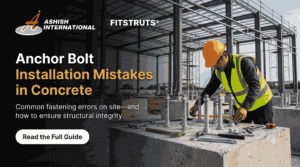

An anchor bolt size selection guide for India comes down to matching four things: the load the bolt must hold, the strength of the concrete, the embedment depth, and the distance from the concrete edge. Put simply, a bigger load needs a larger bolt, set deeper, and kept further from any edge. The most common sizes are M10, M12, and M16 — M10 for light fixings, M12 for medium duty, M16 for heavy structural loads. As a rough guide, in standard C20/25 concrete an M12 bolt at proper embedment resists roughly 19 kN in tension, while an M16 resists around 25 kN or more. Selecting a size means reading a load table for your exact bolt, then checking that your concrete depth and edge distance support that rating. Ashish International, with 25+ years in industrial fasteners, supplies anchor bolts and fixings across the full size range. This guide shows how to choose the right one.
26+
25+
< 12 hr
Have a Requirement in Mind?
The Four Factors Behind Every Size Choice
Picking an anchor bolt is never about diameter alone — four factors work together, and ignoring any one causes failures. These are the four:
- Load — the tension (pull-out) and shear (sideways) force the bolt must resist.
- Concrete strength — a bolt in C40 concrete holds more than the same bolt in C20/25.
- Embedment depth — how deep the bolt sits; deeper means far more pull-out resistance.
- Edge distance and spacing — too close to an edge or another bolt and the concrete cracks before the bolt fails.
Edge distance is the factor most often underestimated: a correctly sized bolt set too near a slab edge can fail at a fraction of its rated load. Get all four right together, not just the diameter, and a fixing is genuinely safe.
Reading an Anchor Bolt Load Table
An anchor bolt load table lists the safe load for each size at a given embedment in a given concrete grade, so you never guess. The chart below gives typical figures for common sizes in standard C20/25 non-cracked concrete.
Size | Typical embedment | Tension (approx.) | Shear (approx.) | Typical use |
M8 | ~60 mm | ~10 kN | ~11 kN | Light brackets, fixtures |
M10 | ~75 mm | ~15 kN | ~19 kN | Light-medium supports |
M12 | ~90 mm | ~19 kN | ~22 kN | Medium MEP and structural |
M16 | ~100 mm | ~25 kN+ | ~42 kN | Heavy structural loads |
M20 | ~116 mm | ~49 kN+ | ~74 kN | Very heavy machinery, base plates |
These are reference values, not final design loads — an engineer applies a safety factor (often around 1.4) and adjusts for real edge distance, spacing, and concrete condition. Note too that shear and tension figures differ for the same bolt, so match the column to how your load actually acts. Reading the table for your exact bolt and concrete is the first real step in sizing.
26+
25+
< 12 hr
Have a Requirement in Mind?
Cracked vs Non-Cracked Concrete
One detail changes the numbers sharply: whether the concrete is cracked or not. The tables above assume non-cracked concrete; in cracked concrete — common in areas under tension, like slab edges or seismic zones — the same bolt holds noticeably less, sometimes a third lower. Confirm which condition your load table describes and which your structure is in, because using a non-cracked figure in cracked concrete is a hidden and dangerous over-estimate.
Embedment and Edge Distance: The Hidden Half
The bolt size on a drawing means little without the right embedment and edge distance, and this is where many fixings quietly go wrong. A common rule of thumb sets embedment at roughly 8–12 times the bolt diameter, so an M12 typically sits around 90–100 mm deep — go shallower and pull-out resistance drops fast. Edge distance matters just as much: keep a bolt at least about 1.5 times its embedment from any concrete edge, or the concrete can break out in a cone before the bolt reaches its rated load. Spacing between bolts follows the same logic — set them too close and they share and weaken the surrounding concrete. These rules are why our foundation and anchor bolts and wedge anchor fixings ship with clear embedment data. Respect depth and edge distance and a bolt delivers the load its size promises.
How to Choose the Right Size, Step by Step
With the factors clear, sizing becomes a short, ordered process. Follow it in this order:
- Find the load — work out the tension and shear the fixing must carry.
- Check the concrete — know its grade and whether it is cracked or non-cracked.
- Pick a candidate size — use the load table to find a bolt that beats the load with margin.
- Verify embedment and edge distance — confirm your concrete depth and edge clearance support that size.
- Match the fastener type — choose a wedge anchor, pin-type anchor, or chemical anchor to suit the base and load.
Most people stop too early at step three, picking a size that just meets the load with no margin for real-site variation. Choose with a safety margin, then verify depth and edge, and a table figure becomes a reliable fixing — the same discipline behind well-designed MEP support structures that rely on these anchors.
26+
25+
< 12 hr
Have a Requirement in Mind?
Fasteners Backed by Manufacturing Depth
An anchor bolt is a safety-critical part — its thread, material, and consistency decide whether a fixing holds — so the maker matters. Ashish International brings 25+ years of fastener manufacturing across three units and 60,000 square feet, at 350 tonnes a month under in-house quality control, so bolts arrive to consistent dimension and thread quality batch after batch. Sourcing companies, stockists, and structural contractors across the UK, Europe, the Middle-East, Australia, and Africa buy from us for that reliability, and several have stayed with us for more than 20 years, some under NDA for proprietary work. We produce anchors, threaded rod, and industrial fasteners to the dimensional and thread standards global specifiers expect, and for brands and MNCs we manufacture the full range as white-label — your spec, your branding, with FITSTRUTS® where a stock line fits. For a full size chart, load data, or a white-label discussion, call +91-99888-54380 or email ashishint2001@gmail.com.
Frequently Asked Questions
Q1. How do I choose the right anchor bolt size?
Start by determining the tension and shear loads the anchor must resist. Then consider the concrete grade, review the manufacturer’s load table, and select an anchor that provides sufficient capacity with an appropriate safety margin. You should also verify the required embedment depth, spacing, and edge distance for the selected anchor. Higher loads may require larger-diameter anchors with greater embedment.
Q2. What is the difference between M10, M12, and M16 anchor bolts?
M10, M12, and M16 anchor bolts differ primarily in diameter, load capacity, and typical application. M10 anchors are generally used for light-to-medium-duty fixings, M12 anchors are suitable for many medium-duty MEP and structural applications, while M16 anchors are commonly used for heavier structural loads. Actual capacity depends on the anchor type, concrete grade, embedment depth, edge distance, and installation conditions.
Q3. How deep should an anchor bolt be embedded?
The required embedment depth depends on the anchor type, diameter, concrete strength, and design load. As a general reference, embedment may be around 8–12 times the bolt diameter, meaning an M12 anchor could require approximately 90–100 mm of embedment in some applications. Always follow the manufacturer’s specified embedment depth and load data for the exact anchor being used.
Q4. Why does edge distance matter for anchor bolts?
Edge distance is important because an anchor installed too close to a concrete edge can cause the surrounding concrete to crack or break out before the anchor reaches its rated capacity. Adequate edge distance and spacing allow the concrete to develop the required strength around the anchor. The minimum distance should always be confirmed using the manufacturer’s technical data and the applicable design standard.
Q5. Do your anchor bolts come with load and embedment data?
Yes. Ashish International can provide anchor bolts with relevant technical information, including recommended embedment depths, hole sizes, and load reference data, to help engineers and installation teams select the appropriate fixing for the concrete grade and application. We also manufacture to customer drawings and specifications, with white-label supply available for stockists, brands, and sourcing partners under NDA where required.

Meet Kriti Mittal, the brand storyteller at Ashish International, a global leader in sheet metal components and industrial fasteners. She specialises in turning technical expertise into engaging stories that highlight the company’s precision, quality, and product innovations. Passionate about manufacturing trends and clear communication, she connects global industries with Ashish International’s vision of performance, trust, and reliability.