
Make in India MEP Hardware | Strut Channel Shift
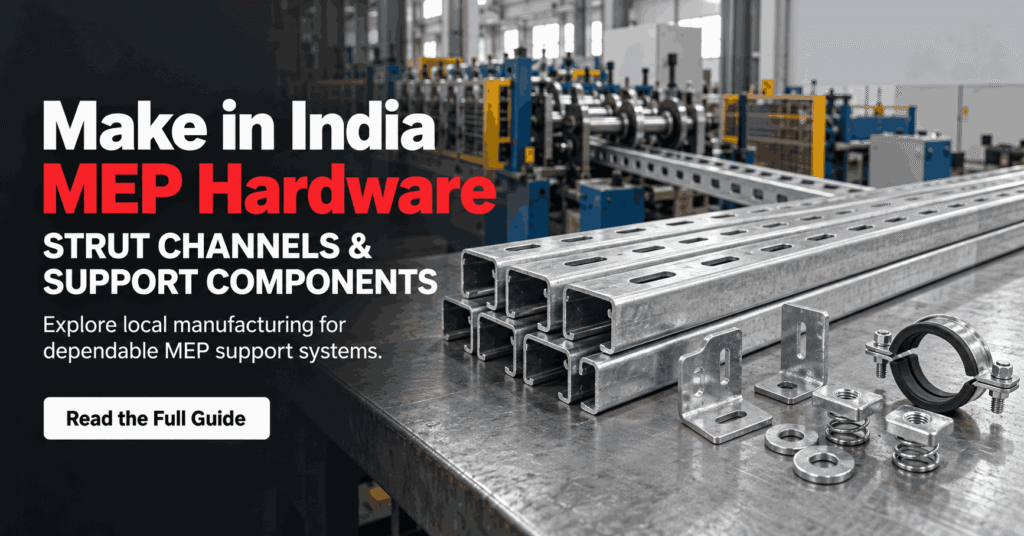
Make in India MEP hardware means sourcing strut channel, brackets, and fasteners from Indian manufacturers instead of importing them, and today the best domestic products match imported unistrut on quality while cutting lead times and cost. For years, specifiers defaulted to imported channel on the assumption it was better made. That gap has closed: leading Indian manufacturers now produce channel to the same dimensions, gauges, and coating standards as global brands, so a domestic part drops straight into a system designed around imported spec. The advantages of buying local are real: shorter delivery, easier support, no import duties or long shipping waits, and supply that keeps pace with fast-moving projects. Ashish International, with 25+ years manufacturing MEP supports, produces strut channel to international standards and exports it worldwide, and this guide compares domestic and imported hardware fairly. Why the Shift to Domestic MEP Hardware Is Happening Several forces are moving specifiers from imported to Indian-made MEP hardware, and they reinforce each other. The main drivers: Quality has caught up: the best Indian manufacturers now match global brands on dimensions, gauge, and coating. Faster supply: domestic sourcing avoids long shipping and customs delays that stall projects. Lower landed cost: no import duties, freight, or currency risk on top of the base price. Easier support: a local maker is reachable for custom sizes, queries, and repeat orders. Policy push: Make in India and import-substitution priorities favour domestic supply on many projects. The change that matters most is the quality one, because it removes the only real reason specifiers used to import. Once domestic quality matches imported, the local advantages of speed and cost decide the choice. Do Indian-Made and Imported Channels Match on Quality? The honest answer is that the best Indian channel now matches imported unistrut, though not every domestic supplier is equal, so the comparison is really about the manufacturer, not the country. A capable Indian maker produces channel to the same 41 mm width and profile dimensions, the same steel gauges, and the same coating standards (Z275, G90, ASTM A123) that global brands use, so fittings interchange and load performance matches. Where domestic supply once varied, established manufacturers now hold tight consistency across bulk orders under proper quality control. The key is to judge a domestic supplier on the same evidence you would ask of any maker: dimensional data, coating standards, and batch consistency, exactly what a strut channel manufacturer should provide. Choose a proven Indian maker and quality is no longer the trade-off it once was. Domestic vs Imported: An Honest Comparison The table below weighs Indian-made against imported MEP hardware on the points that actually decide a purchase. Factor Quality Indian-Made Imported Dimensions & fit Matches global spec Global spec Coating standards Z275 / G90 / ASTM A123 Same standards Lead time Short, domestic supply Longer, shipping + customs Landed cost No import duty or freight Duty, freight, currency risk Custom sizes Direct with the maker Slower, through distributors Support & repeat orders Local, responsive Distance-dependent The rows where domestic clearly wins are lead time and support, since a local maker responds faster and ships sooner. On the quality rows, a capable Indian manufacturer simply matches imported, so there is no longer a quality penalty for buying local. Compare on the full picture and domestic supply is competitive on quality and ahead on speed. What BIS and Standards Mean for Buyers Standards are how a buyer confirms quality regardless of where a product is made. In India, the Bureau of Indian Standards (BIS) sets specifications many fasteners and steel products are made to, alongside international references like ASTM for coatings and IS 1367 for threaded fasteners. A domestic product made to these recognised standards carries the same assurance as an imported one held to equivalent specs. The point for a buyer is simple: ask for the standard, not the passport. A channel made to spec performs to spec wherever it comes from. Rely on documented standards and quality becomes verifiable rather than assumed. How to Switch From Imported to Domestic Supply Moving a project or a supply chain to Indian-made hardware is a short, ordered process: Match the spec: confirm the domestic channel meets the same dimensions, gauge, and coating as your imported part. Request the data: ask for dimensional and coating documentation to compare like for like. Sample and verify: check a sample for fit with your existing fittings and finish quality. Confirm consistency: verify the maker holds spec across bulk orders. Plan the changeover: align the switch with a project phase to avoid mixing systems mid-run. Spec-matching drives step one, because the whole case for switching rests on the domestic part being a true equivalent, not a rough substitute. Verify the match on paper and in a sample, and moving to domestic supply carries no risk to the build. Indian-Made, Built to the World’s Standards The case for Make in India MEP hardware only holds if the domestic maker genuinely matches global quality, and that is what 25+ years of manufacturing proves out. Ashish International runs three units across 60,000 square feet at 350 tonnes a month under in-house quality control, producing channel to the same dimensions and coating standards global specifiers use, which is why we not only supply India but export to Europe, the UK, USA, Australia, the Middle-East, and Africa. Sourcing companies, stockists, and B2B contractors choose us as a domestic and export supplier alike, and several have partnered with us for over 20 years, some under NDA for their own designs. For brands and MNCs we run the full range as white-label, your spec, your branding, with FITSTRUTS® available where a stock line fits, galvanised or stainless to suit. For spec data, samples, or a white-label discussion, call +91-99888-54380 or email ashishint2001@gmail.com. 1. Is Indian-made strut channel as good as imported unistrut? The best Indian-made channel now matches imported unistrut on dimensions, steel gauge, and coating standards, so fittings interchange and load performance is equivalent. Quality depends on the manufacturer,