
MEP Contractor’s Pipe Hanger Buying Checklist
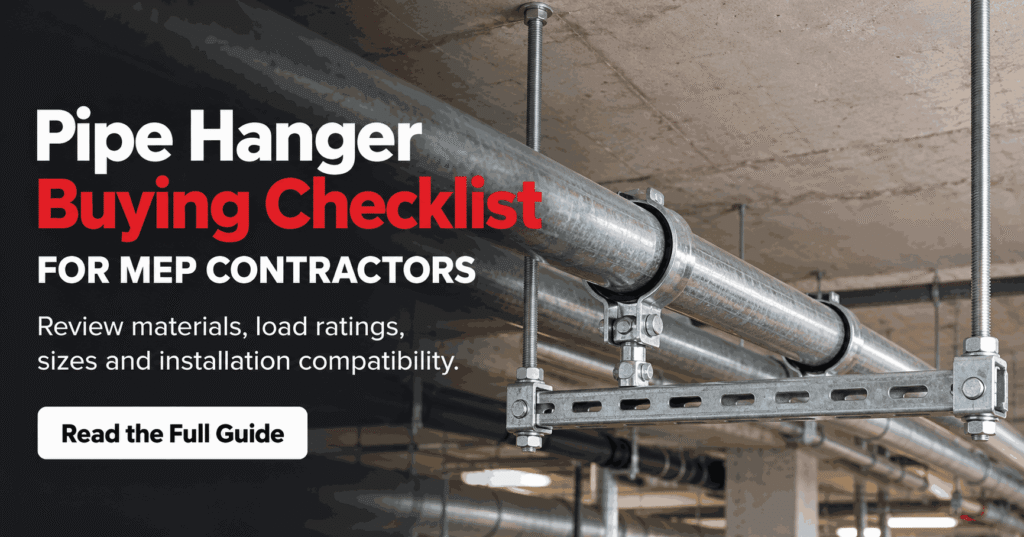
An MEP contractor pipe hanger buying checklist covers the few things worth checking before you place an order, so the supports you buy actually hold, fit, and last. The essentials are simple: confirm the load rating for your pipe and span, check the coating suits the environment, verify the steel gauge and dimensions match spec, make sure the fittings are compatible with your channel, and confirm the supplier can back it with data. A hanger that looks fine but is under-gauged, wrongly coated, or dimensionally off will fail on site or in an audit, costing far more than it saved. Because supports are ordered in bulk and installed once, getting the buying decision right up front matters. Ashish International, with 25+ years manufacturing MEP supports, produces pipe hangers, clamps, and channel to verifiable standards, and this checklist shows exactly what to look for before you buy. Why Pipe Hanger Quality Varies So Much Two pipe hangers can look identical on a shelf and perform completely differently, which is exactly why a buying check matters. The gaps hide in details a photo does not show: the steel gauge may be thinner than spec, cutting load capacity; the zinc coating may be too light for the site, so it rusts early; the dimensions may drift, so fittings do not seat properly; and the load rating may be claimed rather than tested. On a big project, ordering thousands of a sub-standard hanger multiplies every one of these faults across the whole building. This is why experienced buyers judge a hanger on its data and consistency, not its appearance. Know that quality varies beneath the surface, and a buying checklist stops becoming optional. The Buying Checklist, Point by Point Run through these before you commit to an order, in roughly this order of importance: Load rating: confirm the hanger is rated for your pipe weight, filled, at your span; ask for the figure, not a claim. Coating for the environment: pre-galvanised for dry indoor, hot dip galvanised for outdoor, stainless for corrosive or hygienic sites. Steel gauge and dimensions: check thickness and size match the spec, since under-gauge steel silently cuts capacity. Fitting compatibility: confirm the hanger and spring channel nuts suit your strut channel profile. Consistency at volume: for a bulk order, confirm the supplier holds dimensions across every batch. Supporting data: ask for load, coating, and material documentation you can hand to a consultant or auditor. Load rating leads the list because a hanger that cannot carry its filled pipe is the one failure you cannot design around later. Work through the checklist before ordering and a bulk buy becomes a safe buy. Red Flags to Watch For Alongside what to check, a few warning signs should make you pause before ordering. Watch for these: No load data: a supplier who cannot give a load figure is guessing, and so are you. Vague coating claims: “galvanised” without a standard (Z275, G90, ASTM A123) tells you nothing about thickness. Inconsistent samples: if two samples vary in gauge or finish, a bulk order will vary more. Mismatched fittings: nuts or clamps that do not seat cleanly signal off-spec dimensions. Mixed-metal supply: plated nuts shipped with galvanised channel will rust at the joint. The biggest red flag is a supplier who leads with price and cannot produce data, because on supports the cheapest option often costs the most after a failure. Spot these signs early and you avoid a costly order before it ships. What to Verify Before You Commit For a large order, a few verifications turn a leap of faith into a sound decision. The table below sets out what to confirm and why. Verify Why it matters Load rating for filled pipe Ensures the hanger holds the real, water-filled weight Coating standard (Z275 / ASTM A123) Confirms corrosion life suits the site Steel gauge vs spec Under-gauge steel cuts capacity invisibly Dimensional consistency Off-size hangers stop fittings seating Material grade (for stainless) SS 304 vs 316 must match the environment Supplier documentation Data you can hand to a consultant or auditor The verification that saves the most trouble is the coating standard, because a wrongly coated hanger passes inspection on day one and fails quietly years later. Confirm these before you commit and a bulk order carries no hidden surprises. Buy From a Maker Who Can Show Its Work The safest pipe hanger purchase is from a manufacturer who answers every checklist point with data, not adjectives, and that is where real production depth shows. Ashish International brings 25+ years across three units and 60,000 square feet, producing 350 tonnes of MEP support a month under in-house quality control, so load ratings, coatings, and dimensions stay consistent from the first hanger to the last in a bulk order. MEP contractors, procurement teams, stockists, and sourcing companies across the UK, Europe, the Middle-East, Australia, and Africa buy from us because every claim comes with documentation, and several have worked with us for over 20 years, some under NDA for their own designs. We manufacture pipe clamps, riser clamps, and MEP support structures to the standards global specifiers expect, and for brands and MNCs we run the full range as white-label, your spec, your branding, with FITSTRUTS® where a stock line fits. For load data, samples, or a white-label discussion, call +91-99888-54380 or email ashishint2001@gmail.com. 1. What should I check before buying pipe hangers for an MEP project? Confirm the load rating for your filled pipe and span, check the coating suits the environment, verify the steel gauge and dimensions match spec, make sure the fittings are compatible with your channel, and ask for supporting documentation. On bulk orders, also confirm the supplier holds dimensions across every batch. 2. How do I check the quality of a pipe clamp or hanger? Judge it on data and consistency, not looks. Ask for the load rating and coating standard, check the steel gauge against spec, confirm fittings seat cleanly, and compare samples for consistent gauge