Hot Dip Galvanized Anchor Bolts for Outdoor Use
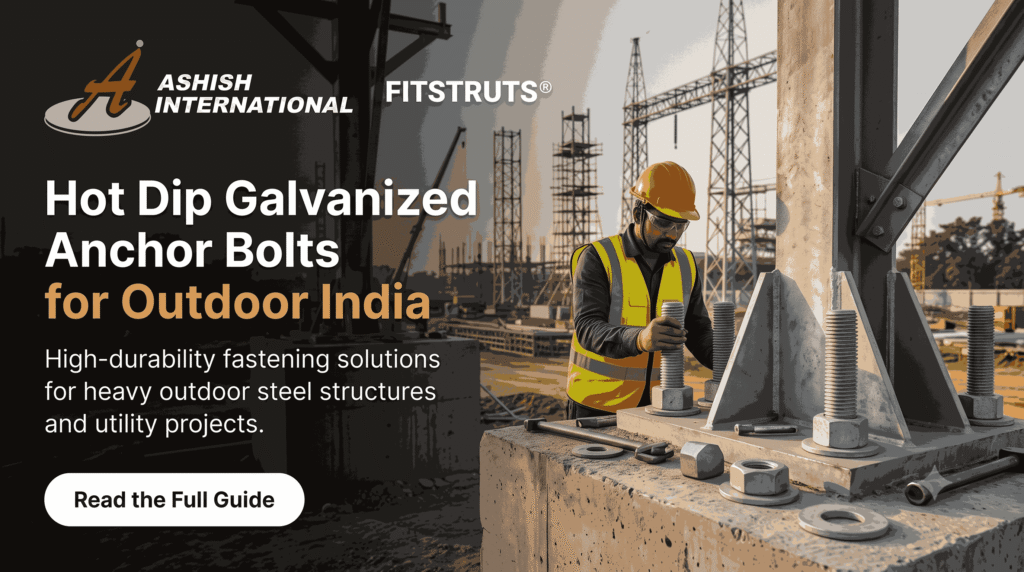
A hot dip galvanized anchor bolt for outdoor use in India is a foundation or fixing bolt coated in a thick layer of zinc, usually 45 to 85 microns, that protects the steel from rust in rain, humidity, and salty coastal air. The zinc is applied by dipping the finished bolt in molten zinc, which coats every surface, thread, and edge, so there are no bare spots to corrode. This makes HDG anchor bolts the standard choice for outdoor structures, rooftop plant, solar frames, and coastal or industrial sites where a plain or lightly plated bolt would rust and fail. The zinc works two ways: it forms a barrier over the steel, and it sacrifices itself to protect any small scratch. Ashish International, with 25+ years in industrial fasteners, produces hot dip galvanized anchor bolts and foundation and anchor bolts to international coating standards, supplied across India and worldwide. Why Outdoor Anchor Bolts Need Hot Dip Galvanising Outdoor and coastal conditions attack unprotected steel fast, and an anchor bolt is one fixing you cannot easily replace once it is set in concrete. Hot dip galvanising answers that for several clear reasons: Thick zinc barrier: an HDG coat of 45–85 microns is three to four times thicker than a pre-galvanised or electroplated finish. Full thread coverage: dipping coats the threads and cut ends, the spots most likely to rust first. Sacrificial protection: if the coat is scratched, the surrounding zinc corrodes first and shields the exposed steel. Long service life: in outdoor and coastal air, HDG lasts far longer than plated or bare steel. The reason HDG matters so much for anchors is that they are permanent: a rusted foundation bolt cannot be swapped without major work, so the coating has to be right the first time. For any outdoor or coastal fixing, hot dip galvanising is the baseline, not an upgrade. How the Zinc Coating Protects the Steel The strength of an HDG anchor bolt comes from how the zinc bonds and behaves. When a finished bolt is dipped in molten zinc at around 450°C, the zinc reacts with the steel to form a series of tough zinc-iron alloy layers, topped by a layer of pure zinc: a metallic bond, not just a surface film. This coating protects in two ways at once: it seals the steel from air and moisture, and it acts as a sacrificial anode, so even a scratch or a drilled edge stays protected as the nearby zinc corrodes first. That is the key difference from a zinc-electroplated bolt, whose far thinner coat wears through quickly outdoors. The thicker the zinc, the longer the life, which is why HDG suits the harshest sites. Because the coating is bonded and self-healing at scratches, it holds up outdoors for decades. Where HDG Anchor Bolts Are Used The right coating follows the environment, and HDG anchor bolts earn their place wherever exposure is real. The table below maps common outdoor settings to why HDG fits. Environment Why HDG is used Coastal and marine sites Salt air drives rapid corrosion; thick zinc resists chloride attack Rooftop plant and HVAC Constant rain and humidity exposure Solar mounting structures Long outdoor life plus wind and weather load Industrial and chemical plants Aggressive, corrosive atmospheres Bridges, towers, and outdoor steel Permanent structural fixings that must last decades Coastal India is the clearest case, where salty air corrodes plated bolts within a short time, making HDG or stainless the only sensible choice. These are the same demanding conditions our wedge anchor and foundation bolt ranges are built for. Match the coating to the exposure and an outdoor fixing stays sound for the life of the structure. The Range We Manufacture Beyond standard HDG anchors, we produce a full range of fixings and coatings to suit different outdoor and structural needs: Anchor and foundation bolts: J-bolts, L-bolts, and straight foundation anchor bolts for base plates and structures. Wedge and pin-type anchors: wedge anchor fasteners and pin-type anchor bolts for concrete fixing. Matched fixings: threaded rod and industrial fasteners in the same coating grade. Stainless options: where even HDG is not enough, stainless anchors for the most corrosive sites. Match every part of a fixing to the same corrosion grade, because a plated nut on a galvanised bolt becomes the weak point that rusts first. Supply the whole fixing to one coating standard and an outdoor assembly stays uniformly protected. How to Order the Right Outdoor Anchor Bolt Specifying an outdoor anchor is a short, clear process, and getting it right saves costly rework later: Confirm the environment: coastal, industrial, rooftop, or general outdoor sets the coating grade. Fix the load and size: match the bolt diameter and embedment to the load it carries. Choose the coating: HDG for most outdoor sites, stainless for the harshest chloride exposure. Match the fittings: nuts, washers, and rod in the same corrosion grade. Confirm the standard: ask for the coating spec (ASTM A123 for HDG) in writing. Environment drives step one, because under-specifying the coating for a coastal site is the most expensive mistake an outdoor fixing can carry. Order to the environment, with matched fittings and a stated standard, and the fixing lasts. Coating That Holds Up Where It Counts An outdoor anchor is judged years later, by whether it has rusted, so the galvanising process behind it is everything. Ashish International brings 25+ years of manufacturing across three units and 60,000 square feet, producing 350 tonnes a month to controlled coating specs, so an HDG order arrives at its stated microns, fully covered on threads and edges. Solar EPCs, infrastructure contractors, stockists, and sourcing companies across coastal and industrial markets in the Middle-East, Australia, Africa, the UK, and Europe rely on that consistency, and several have worked with us for over 20 years, some under NDA for their own designs. We galvanise to the ASTM A123 standard global specifiers use, and for brands and MNCs we produce the full range as white-label: your coating, your branding,
Pharmaceutical Plant MEP Support in India, GMP-Ready

MEP support for a pharmaceutical plant in India means the pipe, cable, and equipment support system built to meet GMP (Good Manufacturing Practice) rules so it stays clean, corrosion-free, and safe for medicine production. In a pharma plant, an ordinary galvanised support will not do: the support must resist rust, harbour no bacteria, withstand harsh washdowns, and shed no particles that could contaminate product. That is why GMP-compliant supports use stainless steel, hygienic crevice-free design, and matched fittings that meet standards like Schedule M and WHO-GMP. The core parts are stainless strut channel for framing, hygienic pipe clamps and hangers, and stainless fixings throughout. Because a contaminated batch or a failed audit is enormously costly, every support must be specified to the cleanroom zone it serves. Ashish International, with 25+ years in MEP supports, produces GMP-grade stainless steel strut channel and support systems for pharma plants, supplied across India and worldwide. Why Pharma Support Rules Are So Strict A pharmaceutical plant is held to a far higher standard than an ordinary factory, and its support system is part of that compliance. The strict rules exist for clear reasons: Contamination control — a rusting or shedding support can drop particles into open product or clean utilities. Repeated harsh washdowns — GMP cleaning uses aggressive agents that quickly attack the wrong material. Auditable compliance — Schedule M and WHO-GMP inspections check that surfaces are cleanable and corrosion-free. No bacteria traps — flat surfaces, open holes, and crevices harbour microbes and fail hygiene checks. Documented materials — auditors expect stated grades and finishes on record. Everything is shaped by one demand: the support must never become a contamination source itself. Design support to pass a GMP audit, not just to hold weight, and it is fit for a pharma plant. What Makes a Support GMP-Compliant A GMP-compliant support is about material, design, and documentation together missing any one can fail an audit. The material must resist the plant’s cleaning chemistry, which is why stainless steel is standard: SS 304 for general and dry cleanroom areas, and SS 316 with added molybdenum for chloride-heavy, acidic, or direct-washdown zones. The design must be hygienic: minimal flat horizontal surfaces where residue collects, no unused open holes, and smooth welds and edges so cleaning is thorough. And every fitting must match stainless spring channel nuts, threaded rod, and pipe clamps, because a single carbon-steel bolt rusts and undoes the whole assembly. Get material, hygienic design, and documented grade right together and a stainless support becomes genuinely GMP-compliant. Matching Support to the Cleanroom Zone Different areas of a pharma plant carry different risk, so support is specified by zone. The table below maps common areas to the right approach. Zone Typical support Key concern Sterile / aseptic areas SS 316, crevice-free design Highest hygiene, direct washdown General cleanrooms SS 304 channel and clamps Cleanable, corrosion-free Utility and process pipe SS 304/316 pipe hangers Chemical exposure, weight Wash bays and wet zones SS 316 throughout Chloride and moisture attack Support corridors / service voids SS 304 or powder-coated Cleanliness, routing The sterile area drives the toughest specification, where SS 316 and crevice-free design are non-negotiable. Match each zone’s support to its cleaning chemistry and hygiene grade and a plant stays audit-ready throughout. How to Specify a GMP Support Package Specifying pharma support is an ordered process, and skipping a step is where audit problems begin: Classify each zone — sterile, general cleanroom, utility, or wet, since this sets the grade. Select the grade — SS 304 for general and dry areas, SS 316 for sterile, chloride, or washdown zones. Design out crevices — specify hygienic profiles, smooth welds, and no open holes. Match every fitting — nuts, rod, clamps, and hangers in the same stainless grade. Document the specification — record grades and finishes for the audit file. Zone classification drives the whole package at step one, because specifying SS 304 into a sterile washdown zone is the most common and costly compliance error. Specify by zone, with matched fittings and documented grades, and a plant passes inspection first time. Materials and Finishes for Pharma Use Beyond the base grade, the finish and build quality complete a compliant support: SS 316 — the choice for sterile, chloride-heavy, and direct-washdown areas, resisting pitting and crevice corrosion. SS 304 — cost-effective for general cleanrooms and dry areas that still need corrosion-free, cleanable support. Powder-coated channel — a clean, low-particle finish for service voids and non-contact routing where stainless is not required. Why Mixed Metals Fail Audits The most common hidden fault is mixing metals a plain-steel or plated bolt on a stainless channel corrodes at the joint, creating a rust point and a bacteria trap that an auditor will flag. Every part of a hygienic support, down to the last washer, must share the corrosion grade. Keep the whole assembly in one matched grade and it protects both the product and the audit result. Support Built to Survive the Audit and the Washdown In pharma, a support is judged twice by the auditor’s checklist and by years of aggressive cleaning so it has to be made right for both. That is where controlled manufacturing counts: Ashish International brings 25+ years across three units and 60,000 square feet, producing 350 tonnes a month under in-house quality control, so SS 304 and SS 316 supports arrive at documented grade with clean, consistent finishes. Pharma EPCs, cleanroom fit-out contractors, stockists, and sourcing companies across the UK, Europe, the Middle-East, Australia, and Africa specify us for that traceability, and several have partnered with us for over 20 years, some under NDA for proprietary designs. We manufacture to the grade standards Schedule M, WHO-GMP, and global specifiers expect, and for brands and MNCs we produce the full range as white-label your grade, your branding, with FITSTRUTS® where a stock line fits. For grade certificates, product specifications, or a white-label discussion, call +91-99888-54380 or email ashishint2001@gmail.com. Frequently Asked Questions Q1. What is GMP-compliant MEP support